Every business wants to know what's coming next.
Will customer demand rise or fall?🤔
Which products will perform best? 🤔
How will market conditions change over the next quarter?🤔
For years, companies relied on historical reports and educated guesses to answer these questions.
Today, that's no longer enough.
The most successful organizations are turning to Forecasting Platform Development to transform data into accurate predictions and strategic business decisions.
At first glance, forecasting may seem like a simple analytics process. Collect data, generate reports, and identify trends.
But modern forecasting platforms are far more sophisticated.
Powered by AI Forecasting Solutions, machine learning algorithms, and real-time data processing, these platforms can identify hidden patterns, predict future outcomes, and continuously improve forecasting accuracy over time.
The question is no longer whether businesses should adopt forecasting technology.
The real question is:
How accurate can your decisions become when you know what's likely to happen before it happens?💭
Let's explore everything you need to know about Forecasting Platform Development.
What is Forecasting Platform Development?
Forecasting Platform Development is the process of building intelligent software systems that analyze historical data, real-time information, and market trends to predict future outcomes.
Businesses today generate more data than ever before.
The real challenge isn't collecting data.
It's knowing what that data is telling you about the future.
Will sales increase next quarter?
How will customer demand change?
Which market trends are likely to emerge next?
At first glance, a forecasting platform may look like a standard analytics dashboard. It collects data, displays reports, and tracks performance metrics.
But modern forecasting platforms do much more than that.
They are designed to analyze historical patterns, process real-time information, and generate accurate predictions that help businesses make smarter decisions.
This is why organizations across finance, healthcare, retail, logistics, and technology are investing heavily in Forecasting Software Development.
The goal is simple: move from reacting to events to predicting them before they happen.
Instead of relying on assumptions, businesses can use predictive intelligence to optimize operations, reduce risk, improve planning, and uncover new growth opportunities.
The latest generation of AI Forecasting Solutions takes this even further. By utilizing artificial intelligence and machine learning, these platforms continuously learn from new data, improve prediction accuracy, and provide real-time insights that adapt to changing market conditions.
How Does a Forecasting Platform Work?
A forecasting platform doesn't just analyze past data it uses advanced algorithms, artificial intelligence, and predictive models to forecast future outcomes with greater accuracy.
At its core, a modern Data Forecasting Platform collects information from multiple sources, processes it in real time, identifies patterns, and generates actionable predictions that help businesses make smarter decisions.
Let's break down the process step by step.
Step 1: Data Collection & Integration 📥
A Data Forecasting Platform gathers information from various sources such as business databases, CRM systems, ERP software, financial records, IoT devices, APIs, social media platforms, and market feeds. The more relevant and accurate the data, the more reliable the forecast becomes.
Step 2: Data Cleaning & Preparation ⚙️
Before analysis begins, the platform organizes, cleans, and standardizes the information to ensure high-quality inputs. This step is critical because even the most advanced forecasting models depend on accurate data.
Step 3: Pattern Recognition Using Machine Learning Forecasting 🤖
Once the data is prepared, Machine Learning Forecasting models begin analyzing historical trends and behavioral patterns. The system identifies relationships between variables, detects recurring trends, and uncovers hidden insights that may not be visible through traditional reporting methods. Over time, machine learning algorithms continuously improve their accuracy by learning from new data.
Step 4: Predictive Modeling & Scenario Analysis 📈
The next stage involves Predictive Modeling Software. Using statistical models, AI algorithms, and forecasting techniques, the platform generates predictions based on historical performance and current market conditions. Businesses can simulate different scenarios, evaluate risks, and understand how specific changes may impact future outcomes before making strategic decisions.
Step 5: Real-Time Forecast Generation ⚡
Modern businesses operate in fast-changing environments where conditions can shift instantly.
This is where Real-Time Forecasting Solutions become essential. As new data enters the system, forecasts are automatically updated, ensuring businesses always have access to the latest insights and predictions. This enables organizations to react quickly to changing customer behavior, market trends, and operational challenges.
Step 6: Visualization & Business Intelligence 📊
Forecasting results are presented through interactive dashboards, reports, graphs, and visual analytics. Decision-makers can easily monitor performance metrics, compare forecasts, track trends, and identify opportunities without needing advanced technical expertise. These insights help teams make faster and more informed business decisions.
Step 7: Continuous Learning & Optimization 🔄
One of the biggest advantages of AI-powered forecasting is continuous improvement.
As more data becomes available, the platform retrains its models, refines predictions, and improves forecasting accuracy over time. This self-learning capability allows businesses to adapt to evolving market conditions and maintain a competitive edge.
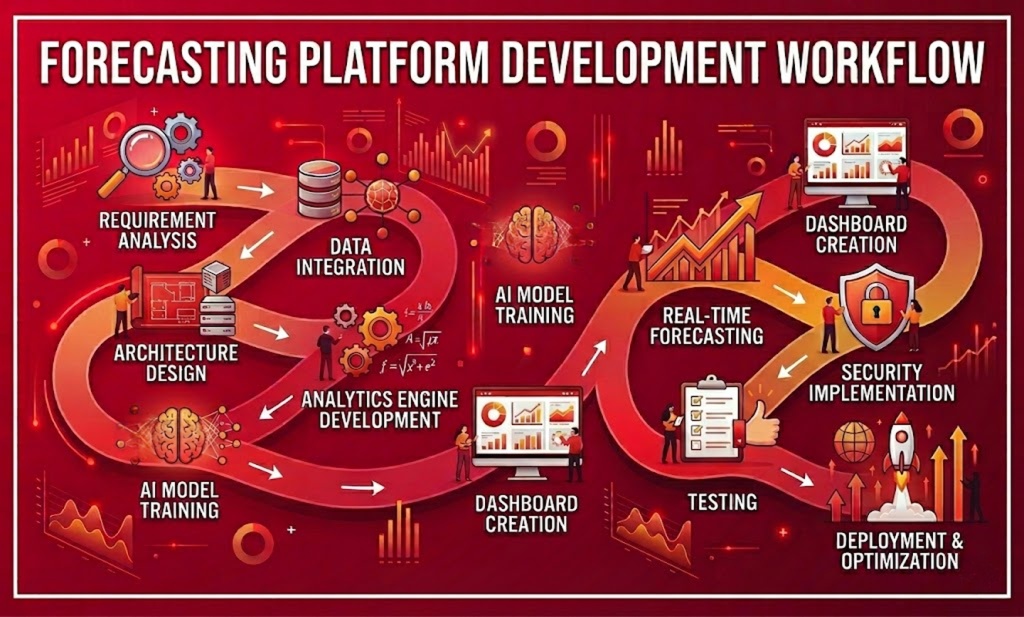
Forecasting Platform Development Process
Building a forecasting platform is not just about creating dashboards and reports. It involves designing an intelligent system that can collect data, identify patterns, generate predictions, and continuously improve forecasting accuracy.
Whether you're developing a business forecasting solution, financial prediction platform, or enterprise analytics system, a structured Custom Forecasting Software Development process is essential for success.
Let's explore the step-by-step development journey.
Key Features of a Forecasting Platform
A modern forecasting platform is much more than a reporting tool. It combines artificial intelligence, predictive analytics, and real-time data processing to help businesses anticipate future trends and make smarter decisions. The best Forecasting Analytics Software empowers organizations to reduce uncertainty, improve planning, and gain a competitive edge through data-driven insights.
Here are the essential features every advanced forecasting platform should include.
AI-Powered Prediction Engine
The foundation of any modern forecasting platform is AI-Powered Forecasting. Using machine learning algorithms and predictive models, the system analyzes historical data, identifies patterns, and generates highly accurate forecasts. Unlike traditional forecasting methods, AI continuously learns from new data, improving prediction accuracy over time and helping businesses adapt to changing market conditions.
Real-Time Data Processing
Advanced Forecasting Analytics Software processes data in real time, ensuring forecasts are continuously updated as new information becomes available. This enables organizations to respond quickly to market fluctuations, customer behavior changes, and operational challenges.
Demand Forecasting & Planning Tools
One of the most valuable capabilities of modern Demand Forecasting Software is its ability to predict future customer demand. Businesses can accurately forecast sales volumes, inventory requirements, production schedules, and resource allocation, helping reduce waste, prevent stock shortages, and optimize operational efficiency.
Advanced Predictive Analytics
A forecasting platform should provide deep analytical capabilities that go beyond basic trend analysis. Through predictive analytics, businesses can evaluate future scenarios, identify risks, uncover opportunities, and understand the factors driving specific outcomes before making strategic decisions.
Interactive Dashboards & Data Visualization
Complex forecasting data becomes actionable when presented through intuitive dashboards. Modern Enterprise Forecasting Solutions offer dynamic charts, graphs, reports, heat maps, and KPI dashboards that help users quickly understand trends and make informed decisions without requiring technical expertise.
Scenario Modeling & What-If Analysis
Forecasting platforms should allow businesses to test different strategies before implementation. What happens if demand increases by 20%? How would a price change impact revenue? Scenario modeling enables organizations to simulate outcomes and prepare for multiple business situations with confidence.
Automated Forecast Generation
Manual forecasting processes are time-consuming and prone to errors. Advanced forecasting platforms automate data collection, model execution, report generation, and prediction updates, significantly improving efficiency and reducing operational workload.
Multi-Source Data Integration
Accurate forecasts require data from multiple business systems. A robust forecasting platform integrates with CRM software, ERP systems, financial databases, cloud applications, APIs, IoT devices, and external market data sources to provide a comprehensive view of business performance.
Customizable Forecasting Models
Every industry has unique forecasting requirements. Modern Enterprise Forecasting Solutions allow organizations to customize forecasting models based on their business objectives, industry dynamics, operational workflows, and performance metrics.
Risk Detection & Opportunity Identification
A powerful forecasting platform not only predicts future outcomes but also highlights potential risks and growth opportunities. Businesses can proactively identify market disruptions, revenue fluctuations, supply chain issues, and emerging trends before they impact operations.
Cloud-Based Scalability
As businesses grow, forecasting requirements become more complex. Cloud-native forecasting platforms offer scalability, flexibility, and high-performance computing capabilities that support growing data volumes and increasing user demands without compromising speed or accuracy.
Enterprise-Grade Security
Forecasting systems often process sensitive financial, operational, and customer data. Leading Enterprise Forecasting Solutions include advanced security features such as encryption, role-based access controls, multi-factor authentication, audit logs, and compliance management to ensure data protection.
Continuous Learning & Model Optimization
One of the most valuable aspects of AI-Powered Forecasting is its ability to evolve. Machine learning models continuously analyze new data, retrain forecasting algorithms, and improve prediction accuracy, ensuring forecasts remain relevant as market conditions change.
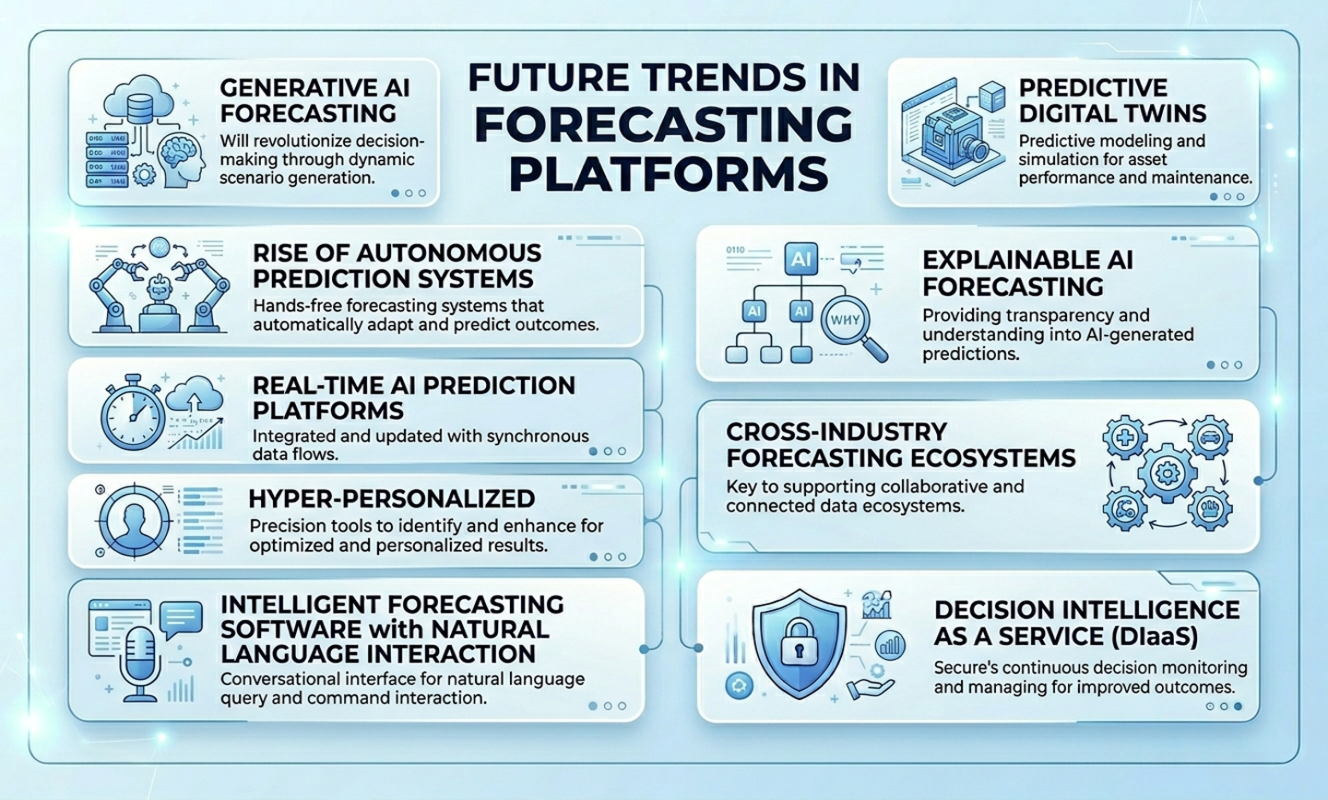
Future Trends in Forecasting Platforms
Forecasting is evolving rapidly. What once relied on historical reports and statistical models is now being transformed by artificial intelligence, automation, and real-time decision intelligence. As businesses demand faster and more accurate predictions, the next generation of forecasting platforms will become smarter, more autonomous, and deeply integrated into everyday operations.
Here are the key trends shaping the future of forecasting technology.
Final Thoughts
In a world where markets shift overnight and customer behavior changes in real time, relying on intuition alone is no longer enough. Businesses need smarter tools, faster insights, and data-driven strategies to stay ahead of the competition.
That's why investing in Forecasting Software Solutions has become a strategic necessity rather than a technological upgrade. From predicting demand and optimizing operations to identifying future opportunities, modern forecasting platforms empower organizations to make confident decisions backed by data.
The rise of AI, machine learning, and predictive analytics is transforming how businesses operate. A powerful AI Forecasting Platform can turn vast amounts of data into meaningful predictions, helping companies reduce risk, improve efficiency, and gain sustainable growth.
Whether you're building a forecasting solution for finance, healthcare, retail, logistics, or enterprise operations, successful Predictive Analytics Platform Development requires the right technology, expertise, and long-term vision.
Partnering with an experienced Forecasting Platform Development Company ensures you have the tools and infrastructure needed to create a scalable, intelligent, and future-ready forecasting ecosystem.
The question is no longer "What happened?"
It's "What happens next?"
And the businesses that can answer that question first will be the ones that lead tomorrow's market. 📈