What if the very system designed to make prediction markets fair is the exact thing being exploited against you?
That's not a hypothetical. It's happening right now quietly, systematically, and profitably for those who know where to look.
Here's the uncomfortable truth most prediction market builders don't want to sit with: your oracle is slow, and someone out there already knows it. By the time your price feed updates, a bot has already read the signal, placed the trade, and walked away with the edge that was supposed to belong to the market.
Welcome to the front-running problem, and no, it's not just a blockchain buzzword. In high-frequency prediction markets, milliseconds aren't a technical detail. They're the difference between a fair market and a quietly rigged one.
We've spent a lot of time obsessing over smart contract security, liquidity design, and market resolution logic. But Oracle latency? It tends to get patched after the damage is done, after someone's already drained value from participants who had no idea the game was tilted.
This blog is about getting ahead of that. We're going to break down exactly how front-running exploits oracle lag, what it costs your market's integrity, and more importantly the practical, implementable strategies to close that gap before it closes you.
What is Oracle Latency?
Oracle latency refers to the time delay between when real-world data (like a stock price, sports result, or event outcome) is generated and when that information is successfully delivered and recorded on a blockchain through an oracle. Since blockchains cannot directly access external data, they rely on oracles as intermediaries, and this process involves multiple steps such as data collection, verification, transmission, and block confirmation.
Even a delay of a few seconds can create a gap where some participants gain early access to information, leading to unfair advantages like front-running. In high-frequency systems, minimizing oracle latency is critical to ensure accurate, fair, and real-time decision-making.
Understanding the Core Problem: Blockchains are Blind
Blockchains are powerful, but they have one major limitation:
They cannot access real-world data on their own.
They rely on external systems called oracles to bring in information such as:
- Sports results
- Financial prices
- Election outcomes
Think of an oracle as a messenger that carries real-world truth onto the blockchain.
But here’s the catch:
That message is never instant.
How the Cheating Actually Works?
Cheating in prediction markets, most commonly through front-running, is not about hacking the system, but about exploiting timing advantages. It happens because there is a small but critical delay between when something happens in the real world and when that information is officially recorded on the blockchain.
Let’s break the process down more clearly and in detail:
1. A Real-World Event Happens Instantly
Everything starts with a real-world outcome like a football match ending, a stock price hitting a level, or an election result being declared.
👉At this exact moment, the truth already exists. The result is final.
2. Off-Chain Data Sources Update First
Within seconds, external platforms such as:
Sports data providers, Financial APIs, and News feeds publish the result. These sources are fast and are often monitored in real time by advanced systems.
👉 At this stage, the result is already publicly available off-chain, but not yet on the blockchain.
3. The Oracle Is Still Processing
The oracle now needs to:
- Detect the update
- Verify the data
- Prepare a transaction
- Submit it to the blockchain
- Wait for block confirmation
This entire process introduces a delay of a few seconds (typically 5–15 seconds).
👉 During this time, the blockchain still shows the market as open and unresolved.
4. Bots Detect the Result in Milliseconds
This is where the exploitation begins.
Sophisticated traders and bots:
- Continuously monitor off-chain data sources
- Detect updates almost instantly (within milliseconds)
- Are programmed to act immediately
👉 They don’t wait for the oracle, they act on real-world truth as soon as it appears.
5. The Exploitation Window Opens
Now we have a short but powerful window where:
- The actual result is already known (off-chain)
- The blockchain still thinks the result is unknown
This creates an information asymmetry:
- Bots have certainty
- Regular users still have uncertainty
6. Guaranteed Bets are Placed
During this window:
- Bots place trades or bets on the correct outcome
- These are not predictions, they are guaranteed wins
Because the market hasn’t closed yet, the system still allows trades.
👉 This is the core of front-running:
Using early access to confirmed information to place risk-free trades
7. Oracle Updates the Blockchain
A few seconds later:
- The oracle submits the result
- The blockchain records it
- The market closes
At this point, the outcome becomes visible to everyone.
8. Profits are Locked In
By the time normal users see the result:
- The opportunity is gone
- The bots have already secured profits
Meanwhile:
- Regular users may have placed losing bets unknowingly
- Liquidity providers or platforms absorb the imbalance
The Latency Gap: Where Exploitation Begins
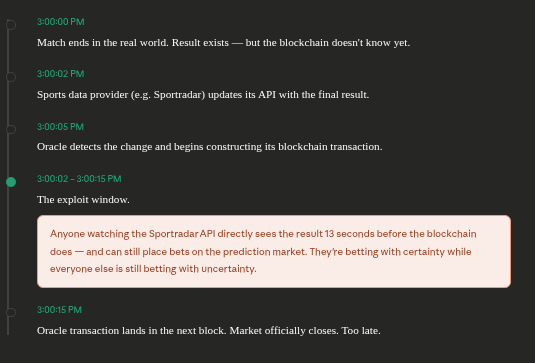
What is Front-Running in High-Frequency Prediction Markets?
Front-running in high-frequency prediction markets is a practice where traders or automated bots exploit tiny time delays to gain an unfair advantage. It happens when some participants access real-world information, like a match result or price movement, before it is officially updated on the blockchain and quickly place trades based on that confirmed outcome.
In these markets, oracles take a few seconds to deliver real-world data on-chain. During this brief window, high-speed bots (operating in milliseconds) can detect the result from external sources and execute guaranteed winning trades before the market closes. This means they are no longer “predicting” outcomes they are acting on certainty, while regular users are still acting on uncertainty.
Why This Problem Is Hard to Solve?
At first glance, it seems simple:
“Just update the blockchain faster.”
But the challenge is deeper.
- The delay happens in multiple layers:
- Data generation (real-world event)
- Data publishing (API update)
- Oracle processing
- Blockchain confirmation
Even if one layer improves, the others still introduce delay.
👉 This makes latency a system-level problem, not just a technical bug.
Why the obvious fix doesn't work?
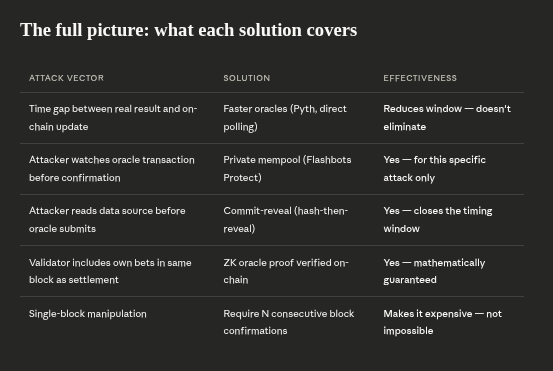
The most commonly suggested mitigation is hiding the oracle's transaction from the public mempool before it's confirmed using services like Flashbots Protect (private mempool routing). This helps, but it only stops one type of attacker: someone watching the public transaction queue.
It does nothing against the more sophisticated attacker who is polling the Sportradar API directly and placing bets based on that data without caring what the oracle's transaction looks like. The root problem isn't transaction visibility. It's the time gap between the result existing in reality and the blockchain registering it. Closing that gap is what actually solves the problem.
Stop Searching- These 3 Solutions Actually Work
Current Problem Flow (Front-Running Happens Here)
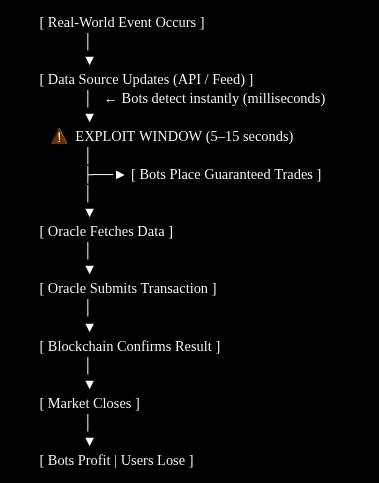
Solution-1: Deployable now
Just make oracles faster
The simplest lever: reduce the polling interval. Services like Pyth Network aggregate signed price data from multiple providers simultaneously, updating every 400 milliseconds. For match results (rather than prices), an oracle can be configured to poll the data source every second and submit a transaction the instant a result appears rather than on a fixed schedule.
This alone shrinks the exploitable window from potentially minutes down to a few seconds. It doesn't eliminate the problem, but it makes systematic extraction dramatically harder. For most markets, this is the first and cheapest fix to deploy.
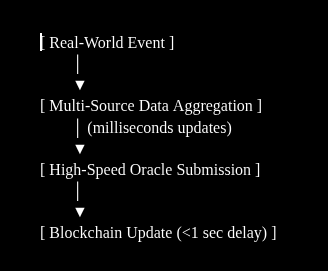
Solution- 2: The clever middle ground
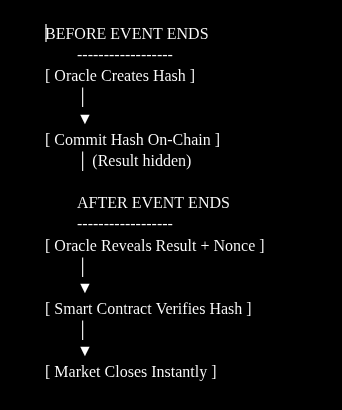
Commit-reveal: The sealed envelope trick
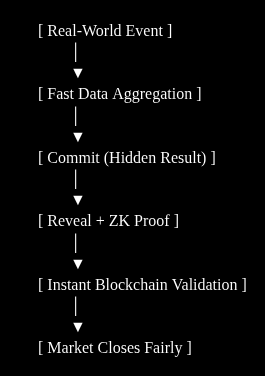
This is the most elegant low-tech solution. Before the event ends, the oracle publishes a cryptographic hash of the result, visible to everyone on-chain, but mathematically unreadable without the original value. After the event ends, the oracle publishes the actual result. Anyone can verify it matches the earlier hash. Betting closes the moment the plaintext result appears.
There's now no window to exploit: by the time anyone can see the real result, the market is closed. The one remaining weakness is that submitting the "sealed" hash is itself a timing signal, bots watching the chain know resolution is imminent. The fix: seal all active markets in a single batch transaction, removing the individual timing signal entirely.
Solution- 3: The mathematically airtight future
ZK oracles: cryptographic proof of data origin
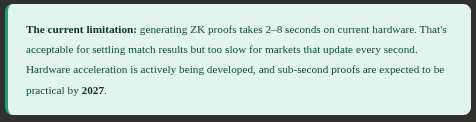
This is the most powerful solution and the one being actively built in 2025–26.
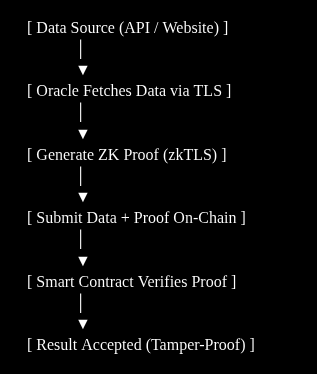
The core idea: what if the oracle could prove mathematically that the data it submitted came directly from ESPN or Sportradar at a specific timestamp, with zero possibility of tampering between the source and the chain?
This is what ZK oracles (built on zkTLS technology) make possible. When a browser connects to a website, it establishes an encrypted TLS connection. ZK oracle technology generates a cryptographic proof of that connection proving that a specific data point came from a specific URL at a specific time, unmodified.
Final Combined Secure Architecture
Ending Note
At the end of the day, this isn’t just a technical challenge, it’s a question of fairness and trust.
Prediction markets are meant to reward insight, not speed advantages. But when a few participants can act seconds ahead of everyone else, the system quietly shifts from intelligent prediction to timing-based exploitation. That’s where the real problem lies.
Solving this isn’t about a single fix, it’s about redefining how these systems are built. Faster oracles help close the gap, commit-reveal removes early visibility, and ZK proofs bring in verifiable trust. Together, they create an environment where outcomes are determined by knowledge, not by who gets there first.
For any prediction marketplace development company, this is no longer optional, it’s foundational. Building scalable platforms in 2026 and beyond means designing systems where latency doesn’t create opportunity for manipulation.
Because the future of prediction markets isn’t just fast it’s fair, transparent, and trust-driven.