What if your trades could execute in milliseconds… while you sit back and watch the results?
Welcome to 2026, where markets are no longer just driven by human decisions but by algorithms, automation, and intelligent systems working around the clock. From algo trading bots that react faster than any human ever could, to prediction market platforms where users trade on real-world outcomes, the financial landscape is evolving at an incredible pace.
But here’s the real question: how do these systems actually work and more importantly, how can you build them?
In this guide, we’ll break down everything you need to know about Algo Trading Bot and Prediction Market Platform Development, from core concepts and technologies to real-world use cases and scalable solutions.
What is an Algo Trading Bot?
An Algo Trading Bot (Algorithmic Trading Bot) is a computer program that automatically executes buy and sell orders in financial markets based on a set of predefined rules or algorithms. These rules are created using market data such as price movements, volume, technical indicators, or timing conditions. Once the strategy is programmed, the bot continuously monitors the market and executes trades instantly when the specified conditions are met, without requiring any manual intervention.
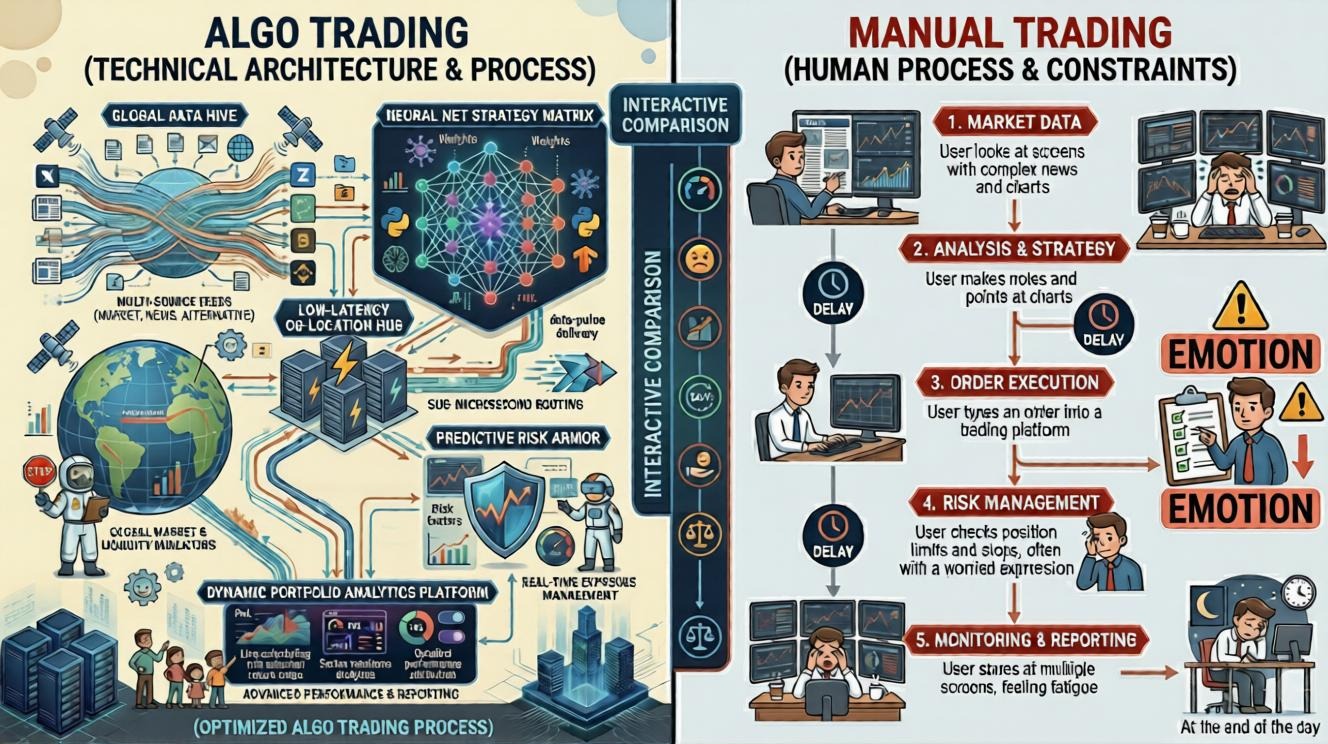
The key advantage of an algo trading bot is its ability to process large amounts of data and react within milliseconds. Unlike human traders, it does not experience emotions like fear or greed, which often lead to poor decision-making. Instead, it follows the logic exactly as programmed, ensuring consistency and speed in execution.
Example-
Consider a simple trading strategy:
A trader wants to buy a stock when its price drops below ₹100 and sell it when the price reaches ₹110.
How Algo Trading Bots Work?
Step 1: Strategy Definition
The process begins with defining a clear trading strategy. This involves setting specific rules that determine when to buy or sell an asset, based on factors such as price levels, timing, or technical indicators. The strategy acts as the brain of the bot, guiding all its decisions.
For example, a trader may define a rule like buying when the price drops below ₹100 and selling when it reaches ₹110. Once these rules are set, the bot strictly follows them without deviation.
Step 2: Data Collection
After the strategy is defined, the bot connects to market data sources such as stock exchanges or cryptocurrency platforms through APIs. It continuously collects real-time data including price movements, trading volume, and market trends. This constant stream of updated information ensures that the bot always has the latest market conditions to work with.
Step 3: Data Analysis
The bot then analyzes the collected data based on the predefined strategy. It continuously evaluates whether current market conditions meet the specified criteria for executing a trade. This analysis happens at high speed, often within milliseconds, allowing the bot to identify opportunities much faster than a human trader.
Step 4: Signal Generation
Once the bot detects that the market conditions match the strategy rules, it generates a trading signal. This signal indicates whether to buy or sell an asset. For instance, if the price falls below the defined threshold, the bot generates a buy signal, and if it rises to the target level, it generates a sell signal. This step is essentially the decision-making phase of the bot.
Step 5: Trade Execution
After generating a signal, the bot automatically executes the trade by sending an order to the trading platform through APIs. It can place different types of orders, such as market orders or limit orders, depending on the strategy. The execution is extremely fast and precise, ensuring that trades are placed at the right moment without delay.
Step 6: Risk Management
To protect against potential losses, the bot incorporates risk management mechanisms. These include setting stop-loss limits to minimize losses, take-profit levels to secure gains, and position sizing to control the amount invested in each trade. This ensures that the trading process remains controlled and does not expose the trader to excessive risk.
Step 7: Monitoring & Adjustment
Once trades are executed, the bot continuously monitors the market and the status of open positions. It can adjust trades based on changing market conditions or close them when predefined targets are achieved. Additionally, the bot tracks performance data, which can be used to refine and improve the strategy over time.
Step 8: Continuous Execution
The entire process runs in a continuous loop, allowing the bot to operate 24/7 without interruption. It keeps collecting data, analyzing conditions, executing trades, and managing risk automatically. This continuous operation enables traders to take advantage of market opportunities at any time without manual involvement.
Why Algo Trading Bots Matter?
1. They Dominate Global Trading Activity
Algorithmic trading is not a niche anymore, it drives the majority of market activity. Studies show that 60–75% of total trading volume in major global markets (US, Europe, Asia) is executed through algorithms.
In some markets, this number goes even higher:
- Up to 70–90% in Forex trading
- Around 40–55% in emerging markets like India
2. Higher Success Rates Compared to Manual Trading
Data indicates that algorithmic trading significantly improves trading outcomes:
- Around 60% of retail algo traders are profitable annually
- Compared to only 5–10% of manual traders
👉 This difference exists because bots:
- Remove emotional decision-making
- Execute trades with precision
- Follow disciplined strategies
3. Massive Institutional Adoption & Profits
Algo trading is heavily used by hedge funds and institutions:
Quant funds generated $543 billion in profits in 2025 alone
👉 This level of capital involvement proves that:
- Algorithmic trading is proven at scale
- It is trusted by the most advanced financial players
4. Speed Advantage
Markets today move extremely fast, and opportunities exist only for seconds or milliseconds.
Algo bots execute trades in milliseconds (less than 1 second)
Humans take seconds or minutes to react
👉 In high-frequency environments:
Speed directly translates into profit opportunities
This is especially critical in:
- Arbitrage trading
- High-frequency trading (HFT)
- Prediction markets
5. Elimination of Human Emotions
One of the biggest reasons traders fail is emotional decision-making:
- Fear leads to early exits
- Greed leads to overtrading
- Panic leads to losses
Algo bots eliminate this completely by:
- Following predefined rules
- Maintaining consistency
- Avoiding impulsive decisions
👉 This is why even though most retail traders (89–95%) lose money, automation helps reduce behavioral mistakes.
6. 24/7 Market Monitoring & Execution
Unlike humans, bots:
- Monitor markets continuously
- Execute trades at any time
- Capture opportunities across time zones
7. Market Efficiency & Liquidity
Algo trading improves overall market quality:
- Faster order execution
- Reduced bid-ask spreads
- Increased liquidity
👉 This makes markets:
- More efficient
- More stable
- More accessible
8. Rapid Industry Growth
The algo trading industry itself is expanding rapidly:
Market size projected to grow from $11.49 billion (2025) to $25 billion by 2035.
Key Features of Algo Trading Software
Strategy Automation
Algo trading software allows traders to define and automate their trading strategies. Once the rules are set such as entry and exit conditions, the system executes trades automatically without manual intervention, ensuring consistency and accuracy.
Real-Time Market Data Integration
The software connects to live market feeds and continuously processes real-time data such as price, volume, and trends. This enables the system to make instant decisions based on the latest market conditions.
High-Speed Execution
One of the most critical features is the ability to execute trades within milliseconds. This speed ensures that traders can capitalize on short-lived opportunities and reduce slippage.
Advanced Analytics & Indicators
Algo trading platforms support various technical indicators like Moving Averages, RSI, MACD, and Bollinger Bands. These tools help in analyzing market trends and making data-driven trading decisions.
Backtesting Capability
Users can test their trading strategies using historical data before deploying them in real markets. This helps in evaluating performance, identifying risks, and optimizing strategies.
Risk Management Tools
The software includes built-in risk controls such as stop-loss, take-profit, and position sizing. These features help minimize losses and protect capital during volatile market conditions.
Multi-Asset & Multi-Exchange Support
Algo trading software can operate across different markets such as stocks, forex, and cryptocurrencies, and can connect to multiple exchanges through APIs for broader trading opportunities.
Customizable Trading Strategies
Traders can customize or build their own strategies based on their preferences, risk tolerance, and market understanding. Some platforms also support scripting or coding for advanced strategies.
24/7 Trading Capability
Unlike manual trading, algo trading systems can operate continuously without breaks, allowing traders to take advantage of opportunities in global markets at any time.
Reporting & Performance Tracking
The software provides detailed reports on trading performance, including profit/loss, win rate, and trade history. This helps traders analyze results and improve their strategies over time.
Architecture of Algo Trading Bot
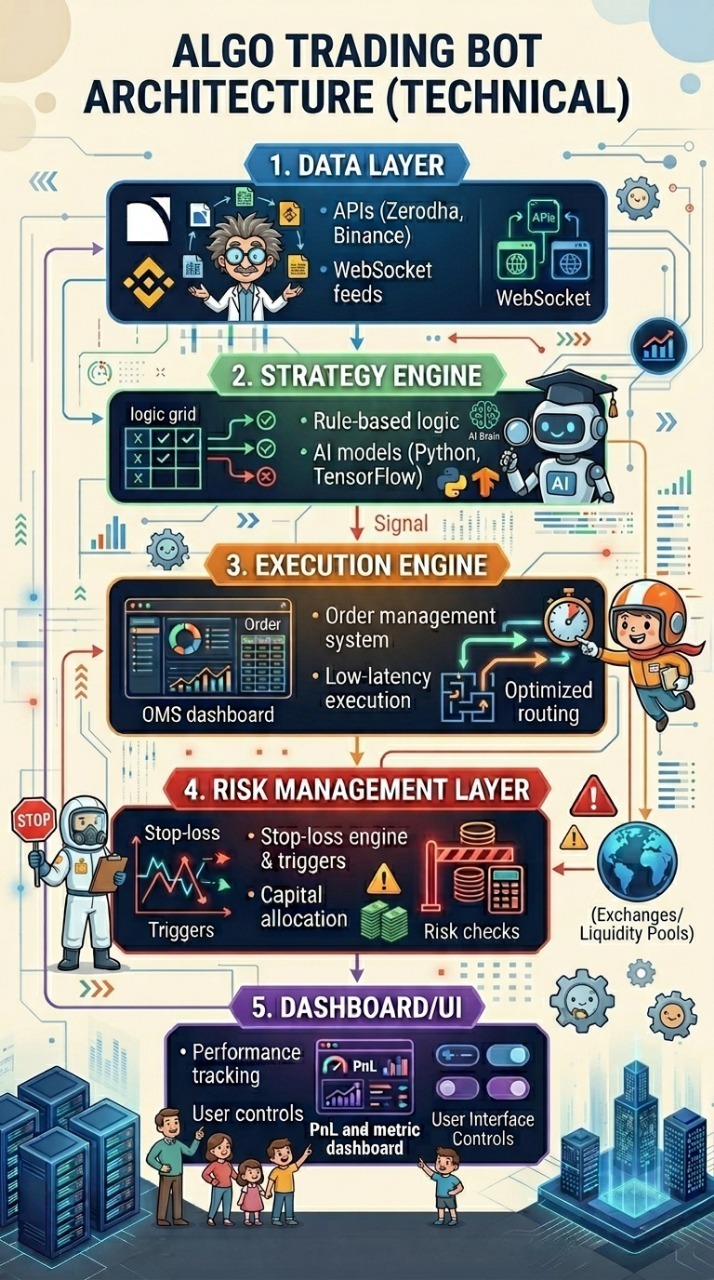
Algo Trading Bot Development Process
1. Define Trading Goals & Strategy
Every successful algo trading bot starts with a clear purpose. Before writing any code, you need to decide what the bot should achieve, whether it’s short-term gains, long-term investing, or specific strategies like arbitrage or trend-following. This stage lays the foundation for everything that follows, as the entire system will be built around this logic.
2. Collect & Analyze Market Data
Once the strategy is defined, the next step is gathering relevant market data. This includes historical price movements, trading volumes, and real-time data feeds from exchanges. Analyzing this data helps identify patterns and trends, ensuring that your strategy is based on solid insights rather than assumptions.
3. Design the Algorithm
At this stage, your trading idea is converted into a structured algorithm. The rules for when to enter or exit a trade, along with risk controls like stop-loss and take-profit levels, are clearly defined. This step transforms your strategy into a format that a machine can understand and execute.
4. Choose Tech Stack & Infrastructure
Selecting the right technologies is crucial for performance and scalability. Developers typically use programming languages like Python or Node.js and rely on cloud infrastructure to ensure the bot can run continuously without interruptions. A strong tech foundation ensures speed, reliability, and flexibility.
5. Develop the Bot
Now comes the actual development phase, where all components are built and integrated. The trading logic, execution engine, and risk management system are coded and connected to work together as a complete system.
6. Backtesting the Strategy
Before going live, the bot is tested against historical market data to evaluate its performance. This helps identify how the strategy would have performed in past market conditions, allowing developers to refine and improve it before risking real money.
7. Paper Trading (Simulation)
After backtesting, the bot is tested in a live market environment without using real funds. This simulation phase helps validate how the bot reacts to real-time conditions and ensures that everything functions as expected.
8. Integrate with Exchange APIs
Once the bot performs well in testing, it is connected to trading platforms through APIs. This allows the bot to access market data in real time and execute trades automatically, bridging the gap between the system and actual trading environments.
9. Deploy the Bot
The bot is then deployed on a secure server or cloud platform where it can operate continuously. Proper deployment ensures stability, uptime, and the ability to handle live trading without interruptions.
10. Monitor & Optimize
Even after deployment, the process doesn’t stop. Continuous monitoring is essential to track performance, detect issues, and adapt to changing market conditions. Over time, strategies are refined and updated to maintain effectiveness.
Algo Trading Bot Pricing (India & Global)
|
Level
|
India Cost
|
Global Cost
|
|
Basic Bot
|
₹15K – ₹40K
|
$3K – $5K
|
|
Mid-Level
|
₹40K – ₹75K
|
$7K – $12K
|
|
Advanced
|
₹1L – ₹5L+
|
$15K – $25K+
|
|
AI Platform
|
₹5L+
|
$100K – $500K+
|
Algo Trading Bot vs Manual Trading
Future Trends in Algo Trading
- The global algorithmic trading market was valued at $21.06 billion in 2024 and is expected to reach $42.99 billion by 2030.
- AI-driven strategies are one of the main drivers of market growth.
- HFT already accounts for a significant share (~44.7%) of automated trading markets
- Trades are executed in milliseconds, capturing micro price movements.
- Algo trading is no longer limited to institutions, retail participation is growing fast
- User-friendly platforms are making it accessible to individual traders.
- Cloud deployment holds the largest share in algorithmic trading infrastructure
- Enables scalability, faster execution, and global access.
- Algo trading is expanding beyond stocks into crypto, forex, ETFs, and derivatives
- Bots can now operate across multiple markets simultaneously.
- Institutional investors still dominate usage due to large capital and infrastructure
- However, competition is increasing with startups and retail traders entering.
- Growth is driven by availability of big data and advanced computing power
- Bots rely heavily on real-time analytics for decision-making.
- Firms like XTX Markets generate billions in revenue using machine learning trading systems.
What is Prediction Market Platform Development?
Prediction market platform development is the process of building a digital platform where users can forecast future events and trade on their outcomes. It combines elements of trading systems, data analytics, and real-time decision-making to create an interactive marketplace driven by user predictions. In simple terms, it’s about creating a system where people don’t just guess what might happen, they invest in their predictions and earn rewards for being right.
How Prediction Market Platforms Work?
Prediction market platforms work like a trading system for future events, where users buy and sell outcomes based on what they believe will happen. Instead of guessing, participants invest in their predictions, and the market itself reflects the probability of those events.
- Event Creation
- User Participation
- Dynamic Pricing Mechanism
- Continuous Trading
- Outcome Verification
- Settlement & Payout
- Data & Insights Generation
Simple Flow Summary
Event → Users Predict → Prices Change → Trading Happens → Result Verified → Winners Paid
Click and know how to build a Decentralized Prediction Market Platform?
Prediction Market Architecture
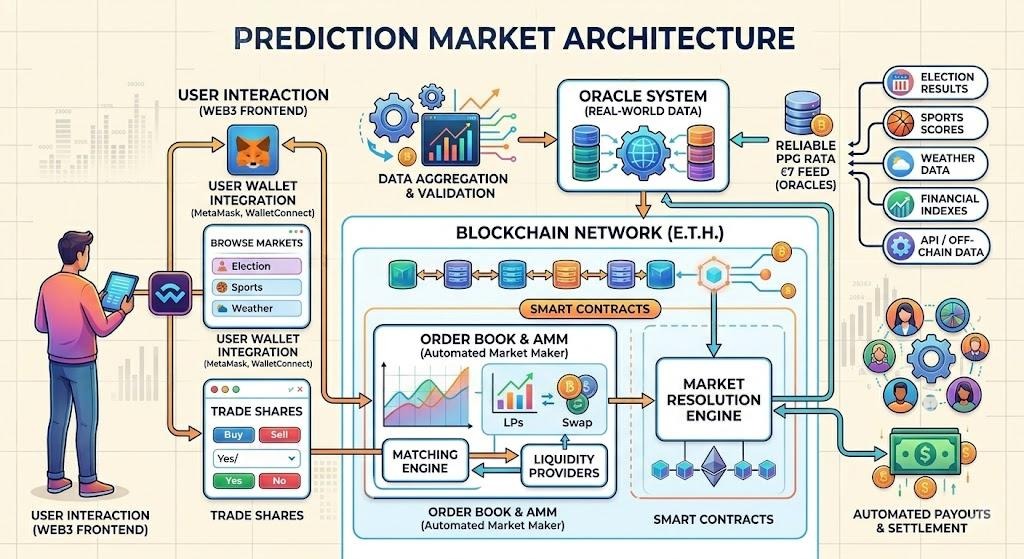
Prediction Marketplace Development Process
Here’s how the development process typically unfolds, step by step:
1. Define the Business Model & Use Case
Everything begins with clarity. You need to decide what type of prediction marketplace you’re building, whether it’s for crypto, sports, finance, or niche events. At this stage, you also define how the platform will generate revenue, such as trading fees or subscriptions.
2. Design the Platform Architecture
Once the concept is clear, the technical foundation is planned. This includes designing the overall system, trading engine, user management, payment flow, and data handling to ensure scalability and performance.
3. Develop the Trading Engine
This is the core of the platform. The trading engine enables users to buy and sell outcome shares, handles order matching, and ensures real-time price updates based on demand and supply.
4. Implement Dynamic Pricing Mechanism
A prediction marketplace relies on price movement. This step involves building algorithms that adjust prices dynamically based on user participation, reflecting the probability of outcomes.
5. Integrate Payment & Wallet System
To enable transactions, secure payment systems or crypto wallets are integrated. This ensures users can deposit funds, trade flawlessly, and withdraw their earnings safely.
6. Build User Interface (UI/UX)
A clean and intuitive interface is essential for engagement. This includes dashboards for market tracking, trading screens, and easy navigation for users to participate without confusion.
7. Integrate Data Oracles for Outcome Verification
The platform must determine results accurately. Data oracles or trusted APIs are integrated to fetch real-world outcomes and ensure fair settlement.
8. Develop Security & Compliance Layer
Security is critical. This step includes implementing encryption, secure authentication, and compliance measures to protect user data and transactions.
9. Testing (Backtesting & Simulation)
Before launch, the platform is tested thoroughly. Simulations are run to ensure the trading engine, pricing system, and payments work smoothly under different conditions.
10. Deployment & Launch
Once everything is validated, the platform is deployed on a cloud server for live usage. This includes setting up scalability, uptime monitoring, and performance optimization.
11. Monitor & Optimize Continuously
After launch, the work continues. User behavior, trading activity, and system performance are monitored to improve features, fix issues, and scale the platform.
Explore the Best prediction market software solutions for startups
Prediction Market Platform Cost
Basic MVP Platform:
👉 $20,000 – $60,000
Standard Mid-Level Platform:
👉 $45,000 – $120,000
Advanced / Scalable Platform:
👉 $70,000 – $600,000+
Get a free quote for Prediction Market Development Cost
Prediction Market vs Traditional Trading
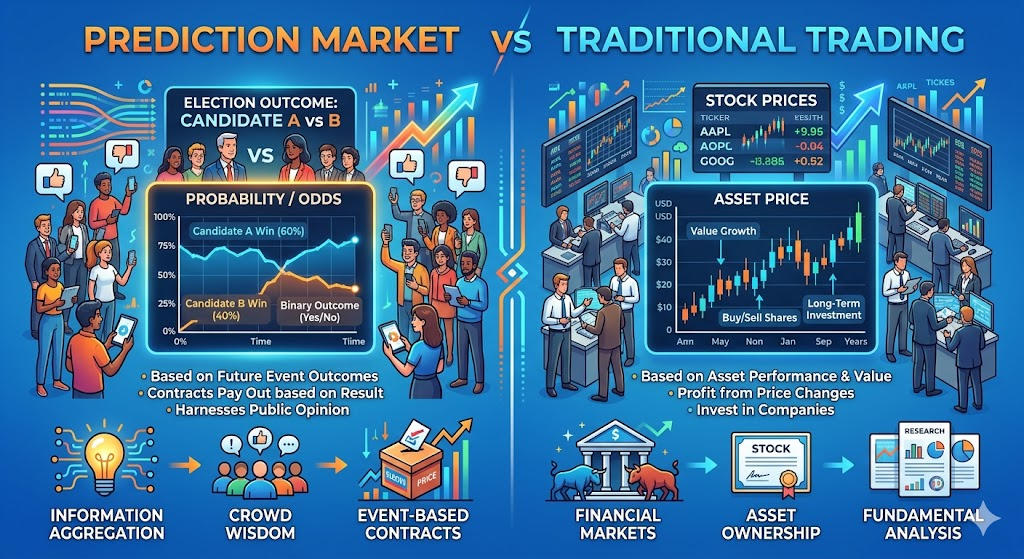
Final Thoughts
As we step deeper into 2026, one thing is clear, the future of trading and forecasting is no longer manual, it’s intelligent, automated, and data-driven. From high-speed execution in financial markets to real-time prediction platforms powered by collective intelligence, the shift is already happening.
Whether you’re exploring algo trading bot development or planning to build a prediction market platform, the opportunity today is bigger than ever. These technologies are not just tools, they’re becoming the foundation of next-generation digital businesses, where speed, accuracy, and automation define success.
The real advantage lies in starting early, building smart, and scaling strategically. With the right approach, you’re not just creating a platform, you’re stepping into an ecosystem where data turns into decisions, and decisions turn into profits.