In today's world, prediction markets are gaining traction as powerful tools for forecasting outcomes, analyzing trends, and even generating revenue. From startups to enterprises, many organizations are exploring launching their own prediction market platforms.
However, one of the most common questions that arises is: how much does it cost to develop a prediction market platform?
The answer isn’t straightforward. The cost depends on multiple factors, including features, technology stack, platform complexity, and development approach. In this blog, we’ll break down everything you need to know about prediction market development costs, helping you make informed decisions.
What is a Prediction Market?
A prediction market is a platform where users trade on the outcome of future events. These events can range from financial markets and sports to politics, entertainment, and even weather forecasts. Users buy and sell shares based on their predictions, and prices fluctuate depending on the perceived probability of an event occurring.
The core idea is simple: collective intelligence leads to more accurate predictions. This makes prediction markets valuable not just for users, but also for businesses seeking actionable insights.
Key Factors Prediction Market Development Cost
1. Platform Type (Web, Mobile, or Both)
The first factor that influences cost is the type of platform you want to build:
- Web platform – More affordable and quicker to launch
- Mobile app (iOS/Android) – Higher cost due to platform-specific development
- Cross-platform solutions – Balanced approach using frameworks like Flutter or React Native
Estimated Cost:
Web only: $2,000 – $6,000
Mobile apps: $5,000 – $10,000+
2. Core Features and Functionalities
The more features you add, the higher the development cost. A basic prediction market platform includes:
User Features
- Easy registration & login
- User dashboard with performance tracking
- Real-time market data
- Event participation (buy/sell predictions)
- Wallet integration (fiat/crypto)
- Leaderboard & rewards system
Admin Features
- Event creation & management
- User management dashboard
- Transaction monitoring
- Commission & fee settings
- Analytics and reporting tools
Advanced Features
- AI-based prediction insights
- Smart contract automation
- Blockchain integration
- Multi-language & multi-currency support
- Social trading & sharing
Estimated Cost Impact:
Basic features: $2,000 – $5,000
Advanced features: $3,000 – $7,000
3. UI/UX Design Complexity
User experience plays a crucial role in the success of a prediction market platform. A clean, intuitive, and engaging interface can significantly improve user retention.
- Basic UI/UX – Standard templates, lower cost
- Custom UI/UX – Unique design, animations, interactive dashboards
Estimated Cost:
Basic design: $500 – $2,000
Advanced design: $2,000 – $4,000
4. Technology Stack
The technologies used in development also impact the overall cost.
Common Tech Stack:
- Frontend: React.js, Angular
- Backend: Node.js, Python
- Database: PostgreSQL, MongoDB
- Blockchain (optional): Ethereum, Binance Smart Chain
Blockchain-based platforms tend to cost more due to smart contract development and security requirements.
Estimated Cost Impact:
Standard tech stack: $3,000 – $8,000
Blockchain integration: $3,000 – $5,000
5. Development Team Location
Where your development team is based can significantly affect pricing:
- India / Southeast Asia – Cost-effective
- Eastern Europe – Moderate pricing
- USA / Western Europe – High cost
Hourly Rates:
India: $20 – $50/hour
Europe: $50 – $120/hour
USA: $100 – $250/hour
6. Third-Party Integrations
Prediction market platforms often require integrations such as:
- Payment gateways
- Crypto wallets
- APIs for real-time data
- KYC/AML verification systems
Estimated Cost:
$1,000 – $3,000 depending on complexity
7. Security and Compliance
Security is critical, especially when real money or crypto is involved. Key security measures include:
- Data encryption
- Two-factor authentication (2FA)
- Secure wallet integration
- Smart contract audits
Estimated Cost:
$1,000 – $4,000
8. Maintenance and Updates
Development doesn’t stop after launch. Ongoing maintenance is essential for:
- Bug fixes
- Feature updates
- Security patches
- Server management
Estimated Cost:
$500 – $2,000/month
Cost Breakdown Summary
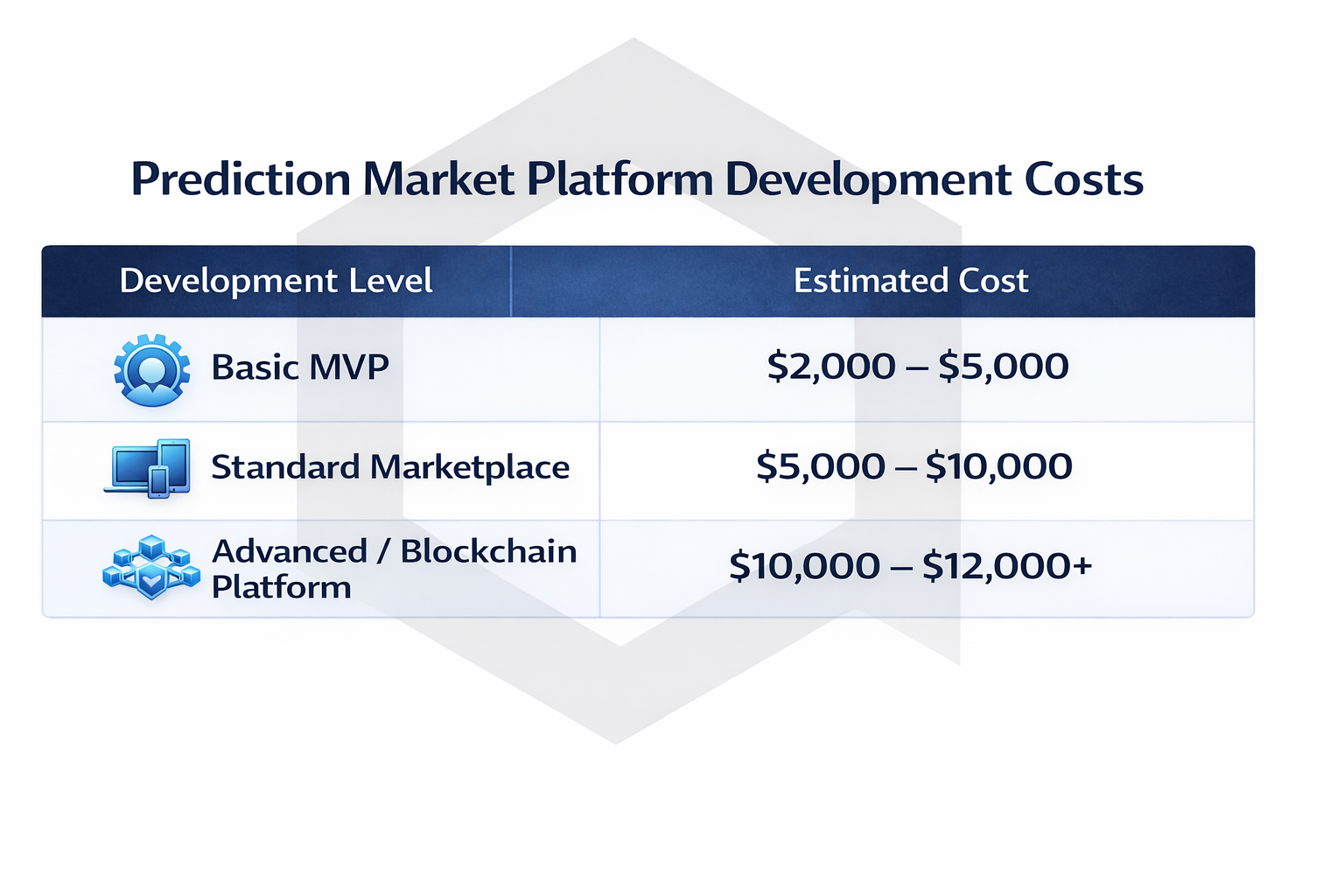
Cost Optimization Tips
If you’re working with a limited budget, here are some ways to reduce costs:
1. Start with an MVP (Minimum Viable Product)
Focus on essential features first, then scale gradually based on user feedback.
2. Use Ready-Made Scripts
Pre-built solutions can significantly reduce development time and cost.
3. Choose Cross-Platform Development
Instead of building separate apps for iOS and Android, use a single codebase.
4. Outsource Development
Hiring experienced developers from cost-effective regions can save money without compromising quality.
Custom Development vs Clone Script
Custom Development
- Fully solution built from scratch
- High scalability for future growth
- Flexible feature customization based on business needs
- Strong performance and security architecture
- Requires higher investment and longer development time
Clone Script
- Ready-made solution with faster deployment
- Cost-effective option for startups and MVPs
- Pre-built core features with minimal setup time
- Limited customization and scalability
- Ideal for quick market entry
Cost Comparison
- Custom Development: $8,000 – $12,000+ (best for long-term, scalable platforms)
- Clone Script: $2,000 – $5,000 (best for quick launch and low-budget projects)
Timeline for Development
The timeline also affects cost:
- Basic platform: 1 – 2 months
- Mid-level platform: 2 – 4 months
- Advanced platform: 4 – 8+ months
Faster development often requires a larger team, which increases cost.
Is Prediction Market Development Worth the Investment?
Absolutely. Prediction markets offer multiple revenue streams, making them a highly attractive business model for startups and enterprises alike. These platforms generate consistent income through:
- Transaction fees
- Commission on trades
- Premium subscriptions
- Advertising opportunities
Beyond direct revenue, prediction markets deliver powerful data insights. By analyzing user behavior and market trends, businesses can gain a deeper understanding of future outcomes, customer sentiment, and emerging patterns.
Additionally, prediction markets create a highly engaging ecosystem where users actively participate, compete, and return regularly, boosting retention and platform growth. Their scalable nature also allows businesses to expand into multiple domains such as finance, sports, crypto, and global events.
With the rise of AI and blockchain technologies, decentralized prediction markets are becoming more secure, transparent, and efficient. This makes them not just a short-term opportunity, but a long-term, future-ready investment for companies.
Why Choose WeAlwin for Prediction Market Development?
Selecting the right development company is crucial for the success of your prediction market platform. A reliable partner not only builds your product but also scalability, security, and long-term growth.
Here’s why Alwin stands out:
Expertise in blockchain solutions
With deep industry knowledge, Alwin delivers advanced platforms aligned with the latest market trends and technologies.
Custom and scalable development approach
Every solution is tailored to your business model, flexibility, and future scalability as your platform grows.
End-to-end support (design, development, deployment)
From initial concept and UI/UX design to development and final deployment, Alwin provides complete support at every stage.
Advanced security implementation
Strong security protocols, data encryption, secure integrations, safe transactions, and user trust.
On-time delivery with cost-effective solutions
Efficient development processes help deliver high-quality platforms on time and within budget.
Final Thoughts
Prediction market development is a promising investment, but the cost can vary widely depending on your goals, features, and technology choices. Whether you’re a startup looking to test the waters or an enterprise aiming to build a full-scale decentralized prediction market platform, understanding the cost structure is essential.
The key is to start small, validate your idea, and scale strategically. With the right approach, a prediction market platform can become a powerful tool for revenue generation.