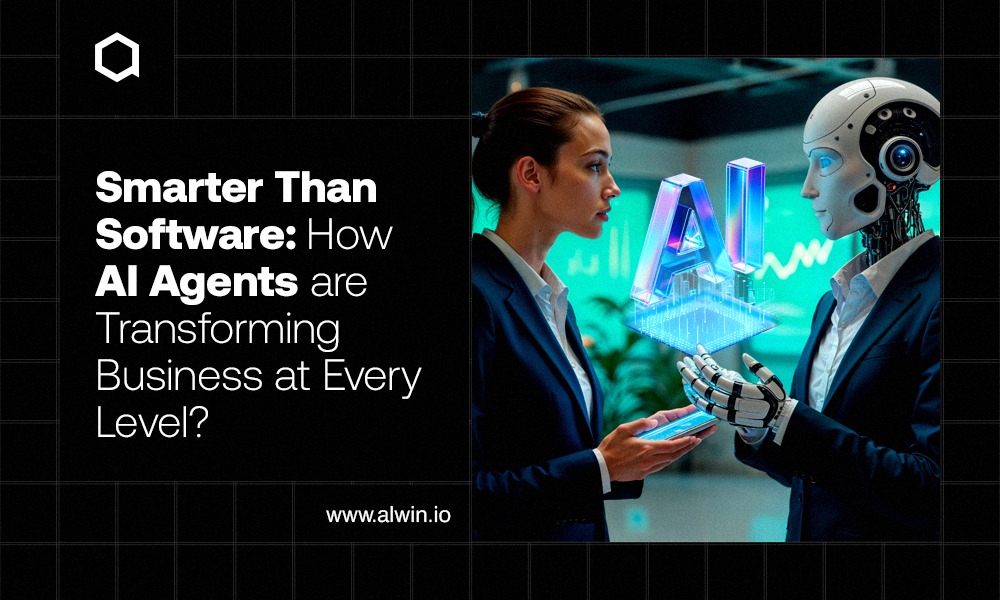
What if business software didn’t just wait for instructions but actively worked toward your goals?
Imagine systems that can analyze data, understand context, make decisions, and execute tasks without constant human supervision. That’s the shift AI agents are bringing to modern businesses.
Unlike traditional software that follows predefined rules, AI agents operate with intelligence and autonomy. They can manage workflows, optimize operations, support customers, assist teams, and even recommend strategic actions in real time. From startups to global enterprises, organizations are adopting AI agents to reduce manual effort, improve accuracy, and accelerate decision-making across departments.
In this blog, we’ll explore how AI agents are redefining business operations at every level, transforming technology from a passive tool into an active digital workforce that drives efficiency, innovation, and sustainable growth.
What are AI Agents?
AI Agents are intelligent software systems designed to perceive information, make decisions, and perform actions independently to achieve a specific goal. Unlike traditional software that works only when explicitly instructed, AI agents can understand context, evaluate situations, and take the next best action automatically.
A Simple Real-Life Example of an AI Agent
AI Customer Support Agent
Imagine you contact an online service because your payment failed.
Instead of a human representative, an AI agent:
- Understands your query using natural language.
- Checks your account and transaction history.
- Identifies the payment issue.
- Suggests or applies a solution automatically.
- Processes a retry or refund if required.
- Sends confirmation and updates your support ticket.
You didn’t guide every step, the AI agent understood the problem and completed the resolution process independently.
This is very different from older chatbots that only provided scripted replies. The AI agent actively works toward solving the issue.
Why Businesses are Adopting AI Agents?
The adoption of AI agents is no longer experimental—it has rapidly become a strategic priority for modern enterprises. Recent industry reports clearly show that organizations across sectors are integrating agentic AI to improve efficiency, automation, and decision-making.
Here are the most important data-driven insights highlighting how businesses are embracing AI agents worldwide:
Global AI Agent Adoption Trends
- 72% of enterprises are already using AI agents, with many deploying multiple agents across business functions.
- Nearly 86% of organizations either have AI agents in production, testing phases, or active adoption plans.
- Around 85% of enterprises are expected to use AI agents by 2025, showing rapid mainstream adoption.
- 96% of enterprises plan to expand AI agent usage as part of future digital transformation strategies.
This indicates that AI agents are shifting from innovation projects to core business infrastructure.
Adoption Across Business Sizes
- 62% of mid-sized businesses already use AI agents in at least one department.
- Startups lead adoption with 71% implementation, compared to 47% among large legacy enterprises.
- Small and medium enterprises adopt AI agents 25% faster than large corporations, driven by accessible SaaS solutions.
Agile organizations are adopting AI agents faster to gain competitive advantage.
Enterprise Deployment & Investment
- 42% of enterprise companies have already deployed AI agents in at least one business unit.
- Over 50% of Fortune 500 companies are actively piloting autonomous AI agents for internal workflows.
- 85% of businesses plan to increase investment in AI agent technologies.
- 93% of business leaders believe organizations scaling AI agents will gain competitive advantage within a year.
AI agents are now viewed as a competitive necessity, not optional innovation.
Functional Adoption Across Departments
Businesses are deploying AI agents in multiple operational areas:
- 63% of organizations use AI agents in customer service operations.
- 45% of enterprises integrate agents into supply chain management.
- 35% of companies use AI agents for data analysis and reporting.
- 68% of retail brands apply AI agents for personalized recommendations.
Business Impact & Performance Gains
Organizations adopting AI agents report measurable results:
- Expected 30% productivity improvement after AI agent implementation.
- Companies experience 6–10% average revenue growth from agent-driven automation.
- 82% of businesses report improved customer satisfaction within six months of deployment.
AI-enabled workflows help reduce operational costs by 15% or more in supply chain environments.
Future Workforce Transformation
- By 2026, 50% of enterprise employees are expected to interact with AI agents daily.
- Adoption of AI agents working alongside employees is projected to grow by 327% within two years.
- Gartner predicts 70% of customer interactions will be handled by AI agents in the near future.
Key Characteristics of AI Agents
AI agents stand apart from traditional software because they are designed to think, adapt, and act intelligently rather than simply execute commands. Their effectiveness comes from a combination of core characteristics that enable autonomous decision-making and task execution.
1. Goal-Oriented Behavior
AI agents operate with a clear objective in mind. Instead of waiting for step-by-step instructions, they focus on achieving a defined outcome.
For example, if the goal is to improve customer response time, the AI agent can prioritize queries, automate replies, and escalate complex issues automatically—all aligned toward that single objective.
2. Autonomy
One of the most important characteristics of AI agents is their ability to function independently. Once deployed, they can perform tasks without continuous human supervision. They analyze situations, make decisions, and execute workflows on their own while still following predefined business rules or goals.
3. Perception and Context Awareness
AI agents continuously gather information from their environment, user inputs, databases, system activity, or real-time data streams. This allows them to understand context rather than reacting blindly. They recognize patterns, user intent, and situational changes before deciding what action to take.
4. Decision-Making Capability
AI agents evaluate multiple possibilities before choosing the best course of action. Using machine learning models and reasoning mechanisms, they determine optimal solutions based on available data.
For instance, an AI agent managing logistics may select the fastest delivery route by analyzing traffic, weather, and delivery urgency simultaneously.
5. Learning and Adaptability
AI agents improve over time through experience and feedback. By learning from past outcomes, they refine future decisions and become more efficient. This adaptability allows them to handle evolving environments without needing constant reprogramming.
6. Proactive Behavior
Unlike traditional systems that only respond when triggered, AI agents can act proactively. They anticipate problems or opportunities and take action before being asked.
Example: Detecting unusual system activity and resolving potential risks before users notice an issue.
7. Interaction and Collaboration
AI agents can communicate with humans, other AI systems, and software platforms. They integrate across tools, APIs, and workflows to complete complex multi-step tasks. This makes them capable of functioning as collaborative digital teammates within organizations.
8. Continuous Execution
AI agents operate 24/7 without fatigue. They monitor processes, manage workflows, and execute decisions continuously, ensuring consistency and efficiency.
AI Agent Workflow
An AI Agent Workflow refers to the structured process through which an AI agent understands a task, analyzes information, makes decisions, and executes actions automatically to achieve a specific goal.
Instead of performing a single action, AI agents follow a continuous workflow cycle—very similar to how humans think, plan, and act while completing a task.
In simple terms:
👉 Input → Thinking → Decision → Action → Learning
Let’s break down the workflow step by step.
Steps in an AI Agent Workflow
1. Goal Definition
Every AI agent starts with a clear objective or task.
This goal can be:
- Resolving customer queries
- Processing transactions
- Optimizing delivery routes
- Managing workflows
The system understands what outcome needs to be achieved, not just what action to perform.
Example: Reduce customer response time.
2. Data Collection (Perception Stage)
The AI agent gathers relevant information from different sources such as:
- User inputs
- Databases
- APIs
- Sensors or system logs
- Historical records
This step allows the agent to understand the environment before acting.
Example: Collecting customer history, query details, and account status.
3. Context Understanding & Analysis
Once data is collected, the AI agent analyzes it to understand context and intent.
It identifies:
- Patterns
- User needs
- Possible problems
- Available options
This stage converts raw data into meaningful insights.
Example: Detecting whether a customer issue is billing-related or technical.
4. Decision-Making
The AI agent evaluates multiple possible actions and selects the most effective solution based on predefined goals and learned behavior.
Decision-making may involve:
- Predictive models
- Rule evaluation
- Risk assessment
- Probability analysis
Example: Choosing whether to resolve an issue automatically or escalate it.
5. Action Execution
After deciding, the AI agent performs the required task automatically.
Actions may include:
- Sending responses
- Updating systems
- Triggering workflows
- Processing payments
- Scheduling operations
Example: Issuing a refund or resetting an account instantly.
6. Feedback Monitoring
The agent monitors results after execution to verify whether the goal was successfully achieved.
It checks:
- User satisfaction
- System response
- Performance outcomes
Example: Confirming whether the customer problem was resolved.
7. Learning & Optimization
AI agents continuously learn from outcomes and feedback.
They improve by:
- Adjusting decision strategies
- Refining predictions
- Avoiding past errors
Over time, performance becomes faster and more accurate.
Example: Future similar issues get resolved automatically with higher accuracy.
AI Agent Workflow Cycle
Goal → Observe → Analyze → Decide → Act → Learn → Improve
This cycle repeats continuously, enabling autonomous operation.
Ending Thoughts
AI agents are no longer just a glimpse of the future, they’re rapidly becoming a core part of how modern businesses operate today. What once required constant human supervision, manual coordination, and complex software management can now be handled by intelligent systems that understand goals, make decisions, and execute tasks independently.
From improving customer experiences to optimizing operations and accelerating decision-making, AI agents in gaming are transforming technology from passive software into an active business partner. They don’t simply automate work, they enhance how work gets done across every level of an organization.
As businesses continue to evolve in an increasingly digital and data-driven world, the real advantage will belong to those who embrace systems that can learn, adapt, and act in real time. The question is no longer whether AI agents will shape the future of business, it’s how quickly organizations are ready to work alongside them.
In a world moving toward intelligent automation, AI agents aren’t replacing businesses they’re empowering them to operate smarter, faster, and more efficiently than ever before.