Imagine four friends sitting inside a café.
One says: "I use Hyperliquid because it's fast."
Another replies, "I trust dYdX because it's established."
The third says: "GMX pays me while I trade."
The fourth smiles and says: "Jupiter does everything on Solana."
Five years ago, this conversation would have sounded strange.
Today, it's happening everywhere.
Crypto traders are no longer asking:
"Which exchange should I trust?"
They're asking:
"Which platform gives me control without sacrificing speed?"
That single question is reshaping the entire trading industry.
2026 is no longer about centralized versus decentralized.
It's about who builds the best trading experience.
And four names keep appearing repeatedly.
Hyperliquid.
dYdX.
GMX.
Jupiter.
Let's compare them from a real trader's perspective.
Why Is Everyone Suddenly Talking About Perpetual DEX Platforms?
A few years ago, most people traded crypto through centralized exchanges because they were simple and familiar. But things are changing quickly. Today, more traders are paying attention to Perpetual DEX platforms because they offer something many users have been asking for: greater control, faster execution, and a better trading experience without depending entirely on a third party.
Here's why the conversation around Perpetual DEXs is growing in 2026.
1. People Want True Ownership Through Self-Custody
One of the biggest reasons behind the rise of Perpetual DEX platforms is self-custody.
In traditional exchanges, users deposit their funds into a company-controlled account. While convenient, this means traders don't have complete control over their assets.
Perpetual DEX platforms work differently. Users connect their own wallets and keep ownership of their funds throughout the trading process. This shift is becoming more important because people are realizing a simple truth:
If someone else controls your assets, you're depending on them every time you trade. Self-custody gives users more confidence, transparency, and independence.
2. On-Chain Trading Is Becoming Much Faster
In the past, decentralized trading often had a reputation for being slow and expensive.
That is no longer the case. Modern perpetual DEX platforms now use advanced infrastructure, dedicated blockchains, and optimized execution engines that allow trades to happen within seconds.
Today's traders expect the following:
- Faster order execution
- Lower transaction costs
- Reduced network congestion
- A smoother trading experience
The technology has matured enough to compete with traditional trading platforms.
3. Institutional Investors Are Starting to Pay Attention
Perpetual DEXs are no longer attracting only retail traders. Large investors, trading firms, and institutions are increasingly exploring decentralized markets because they offer greater transparency and direct market access.
Institutions value several advantages:
- Transparent on-chain activity
- Reduced reliance on intermediaries
- Global accessibility
- Continuous market availability
As institutional participation increases, confidence in decentralized trading ecosystems also grows.
4. The User Experience Has Improved Dramatically
Years ago, decentralized trading could feel overwhelming, especially for beginners. Today, many Perpetual DEX platforms are designed with simplicity in mind.
Users can now access features such as the following:
- Easy wallet connections
- Clean and intuitive dashboards
- Advanced charting tools
- Risk management features
- Cross-chain capabilities
The experience is becoming closer to what users expect from modern financial applications, without sacrificing decentralization.
5. Traders Want Less Dependence on Centralized Exchanges
Over time, many crypto users have learnt that depending entirely on centralized platforms comes with risks. Service interruptions, account restrictions, regional limitations, and platform-related uncertainties have encouraged traders to look for alternatives.
Perpetual DEX platforms provide another option. Instead of handing over complete control to a company, users can trade directly through decentralized systems while maintaining ownership of their assets.
This doesn't necessarily mean centralized exchanges will disappear, but it does mean traders now have more choices. And many are choosing platforms that prioritize transparency and control.
Hyperliquid - The Trader Who Never Sleeps
If Formula 1 built a crypto exchange, it would probably look like Hyperliquid.
Imagine entering a platform where everything happens in seconds. No unnecessary waiting, no complicated screens, and no feeling of being left behind during a fast-moving market.
That's one of the biggest reasons traders are paying attention to Hyperliquid.
Crypto markets never sleep. Prices can rise or fall at any moment, and traders need a platform that can keep up with that pace. Hyperliquid was built with speed and efficiency at its core.
Speed That Matches Market Movements
In trading, even a few seconds can make a huge difference. Hyperliquid is designed to execute trades quickly, helping users react to market changes without delays.
For active traders, faster execution means fewer missed opportunities.
A User Experience That Feels Simple
Many trading platforms can feel overwhelming, especially for beginners. Hyperliquid focuses on creating a cleaner and more intuitive experience.
Users can access charts, place orders, and monitor positions without navigating through complicated menus.
The goal is simple: spend less time figuring out the platform and more time focusing on trading.
An Order Book Model That Feels Familiar
Unlike many decentralized exchanges that rely only on automated systems, Hyperliquid uses an order book model.
This allows traders to place buy and sell orders at specific prices, similar to traditional financial markets and centralized exchanges.
For experienced traders, this creates a more familiar environment.
Deep Liquidity Creates Better Trading Conditions
Liquidity is one of the most important factors in trading.
When a platform has deep liquidity, traders can execute large orders more smoothly with less price impact.
This helps create a more stable and efficient trading experience for everyone.
Why Is Hyperliquid Gaining Market Attention?
Hyperliquid is growing because it combines several things traders have been asking for:
- Fast execution
- A simple user interface
- Professional trading tools
- Strong liquidity
- A seamless decentralized experience
Instead of forcing users to choose between speed and self-custody, Hyperliquid is trying to deliver both.
dYdX – The Wall Street Professional Inside DeFi
dYdX is built for users who want a more professional trading experience rather than a simple buy-and-sell platform. It combines traditional trading concepts with decentralized finance.
Institutional Mindset – dYdX is designed with a professional approach, attracting traders who value strategy, precision, and long-term market participation.
Advanced Tools - The platform offers trading features and analytical tools that help users make more informed decisions.
Risk Management – dYdX emphasises disciplined trading by providing tools that help traders monitor and manage their risk effectively.
Professional Trading Environment - Its interface and features are designed to create a structured environment that feels familiar to experienced traders.
GMX - The Exchange That Rewards Patience
Unlike many trading platforms that focus only on active traders, GMX also creates opportunities for users who want to earn by supporting the ecosystem.
GLP Model - GMX uses the GLP model, a liquidity pool that helps power trading activity across the platform.
Liquidity Provider Benefits - Users who contribute assets to the liquidity pool can earn a share of the platform's fees.
Passive Earning Opportunities – GMX allows users to potentially generate rewards even when they are not actively placing trades.
Sustainable Ecosystem – The platform is designed to balance the needs of traders and liquidity providers, helping create a more stable ecosystem over time.
Jupiter - The Super App of Solana Trading
Jupiter feels less like an exchange and more like a crypto operating system. Instead of offering a single service, Jupiter brings multiple trading tools together in one place, making the Solana trading experience faster and simpler.
Solana Ecosystem - Jupiter is deeply connected to the Solana ecosystem, allowing users to access fast and low-cost transactions.
Aggregation Technology – It searches across multiple liquidity sources to help users find better trading routes and efficient prices.
User Experience - Jupiter focuses on a clean and easy-to-use interface, making advanced trading tools more accessible.
Cross-Functional Tools – Beyond token swaps, Jupiter offers multiple features that help users manage different trading activities within one platform.
Which Platform Is Best For Your Trading Personality?
Not all traders are the same. There is no single platform that works for everyone. The best choice depends on your trading style, goals, and how you prefer to interact with the market.
|
Trader Type
|
Recommended Platform
|
|
Day Trader
|
Hyperliquid
|
|
Professional Trader
|
dYdX
|
|
Passive Investor
|
GMX
|
|
Solana Ecosystem User
|
Jupiter
|
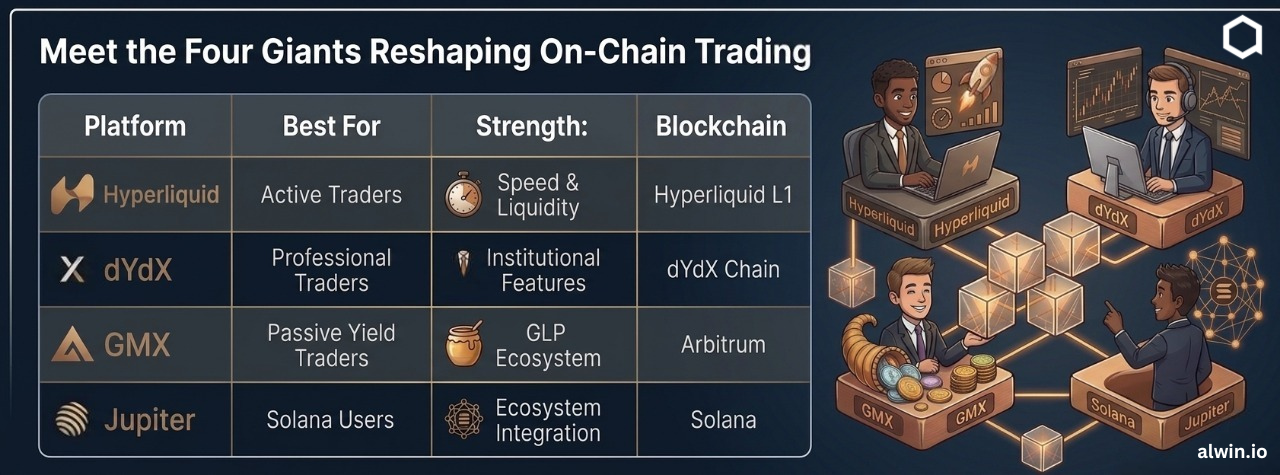
- Hyperliquid is ideal for traders who prioritise speed and active market participation.
- dYdX is better suited for experienced traders seeking professional tools and a structured trading environment.
- GMX appeals to users looking for passive earning opportunities alongside trading.
- Jupiter is a strong choice for users already active in the Solana ecosystem.
Why Infrastructure Builders Are Paying Attention To This Trend?
As perpetual trading continues to grow, businesses are realising that users expect more than basic trading platforms. They want speed, scalability, and a seamless trading experience.
That is why many companies are partnering with a decentralized exchange development company to build advanced trading ecosystems that can adapt to future market demands.
Modern businesses are no longer focused on creating generic exchanges with standard features. Instead, they are investing in intelligent infrastructure with better performance, stronger security, and user-centric experiences.
As decentralized finance evolves, this shift toward smarter and more scalable trading platforms is expected to grow even faster in the coming years.
"The winners of 2026 won't be the platforms with the most features. They'll be the ones that make complexity invisible."
Conclusion
Let's go back to that café. Those four friends were never arguing about technology. They were actually answering a bigger question.
"What kind of trader do I want to become?"
Because in 2026, traders are no longer choosing exchanges.
They're choosing experiences.
Hyperliquid is speed.
dYdX is professionalism.
GMX is sustainability.
Jupiter is ecosystem convenience.
And the real winner?
It won't be a platform.
It will be the users who understand where the market is heading before everyone else does. The future of trading is no longer being built behind closed doors. It's happening directly on-chain, one transaction at a time.