What if a property worth $10 million could still leave its owner waiting months or even years to access its value?
That is one of real estate's biggest contradictions.
A property can represent significant wealth, yet turning that value into usable capital is rarely quick. Selling may require finding the right buyer, negotiating terms, completing due diligence, preparing legal documents, securing financing, and navigating a lengthy closing process.
For investors, the challenge is similar. Buying an entire property can require substantial capital, while exiting the investment may depend on finding another suitable buyer.
So, if real estate is so valuable, why can accessing that value still be so difficult?
Tokenization offers a different way to think about the problem.
By representing eligible real estate interests or economic rights through digital tokens, tokenization can potentially make certain investments easier to divide, manage, and transfer.
But does putting real estate on a blockchain actually solve the liquidity problem?
Not by itself.
Instead, tokenization can potentially address three structural barriers: large investment requirements, limited exit options, and transaction friction.
Let's look at how.
Why Is Real Estate So Difficult to Liquidate and How Can Real Estate Tokenization Platform Development Help?
Before looking at the three potential solutions, it helps to understand why traditional real estate can be difficult to liquidate in the first place.
Imagine an investor owns an interest in a commercial property in Texas.
The property may be valuable, but selling that investment isn't as simple as selling a publicly traded stock. The investor may need to identify a buyer, negotiate the price, complete due diligence, review legal documents, satisfy financing conditions, and complete the required transfer process.
Several barriers can slow the process:
- High capital requirements can limit the number of potential buyers.
- Limited buyer pools can make large properties harder to sell.
- Long transaction cycles can keep capital tied up.
- Extensive paperwork can increase administrative work.
- Due diligence requirements can add additional time.
- Complex ownership structures can make transfers more complicated.
- Geographic and regulatory restrictions can limit participation.
This creates an important question:
What if investors didn't always have to buy or sell the entire property?
That's where RWA Tokenization Platform Development Company enters the picture.
A tokenization platform can provide infrastructure for representing eligible real estate interests or economic rights as digital assets. Instead of treating a property investment as one large transaction, the underlying investment structure can potentially be divided into smaller units.
However, tokenization doesn't automatically create a liquid market.
The outcome depends on the legal structure, applicable regulations, investor eligibility, transferability, market demand, and the infrastructure supporting transactions.
So the real question isn't whether blockchain can represent real estate.
It's whether tokenization can make the investment structure more accessible and transferable.
Can Fractional Ownership Make Real Estate More Accessible?
Way 1: Reduce the Capital Barrier Through Fractional Ownership
What if you didn't need to buy the entire property to participate in its investment potential?
That's the idea behind fractional ownership.
Traditional real estate can require significant upfront capital. A $10 million commercial property, for example, may be accessible primarily to institutional investors, large investment groups, or individuals with substantial capital.
Tokenization can potentially divide an eligible real estate interest into smaller digital units.
Instead of one investor acquiring the entire investment, multiple eligible investors could potentially participate in a structured offering.
This can create several potential benefits:
- Lower investment minimums
- Fractional participation
- Broader investor access
- Greater portfolio diversification
- Digital representation of eligible investment interests
A Simple Example
Consider a commercial property valued at $10 million.
Rather than requiring a single investor to provide the entire purchase amount, an appropriately structured investment could potentially represent the economic interest through smaller units.
An investor could then gain exposure to a portion of the investment rather than committing capital to the entire property.
For US investors, this model could potentially open access to certain real estate opportunities that traditionally required much larger commitments.
But there is an important legal distinction.
A token does not automatically represent direct title to the physical property.
Depending on the legal and regulatory structure, a token could represent an interest in an LLC or SPV, a contractual right, an economic interest, or another legally defined arrangement.
Therefore, the legal structure needs to establish exactly what the investor receives and what rights are attached to the token.
Fractional ownership can potentially make real estate easier to access.
But accessibility solves only one side of the problem.
What happens when an investor wants to exit?
Can Secondary Markets Give Investors More Exit Options?
Way 2: Create Infrastructure for Potential Secondary-Market Transfers
Buying a smaller investment interest may be easier.
But what if the investor needs to sell?
That's where the traditional real estate model can become challenging.
An investor may have to wait for:
- A property sale
- Refinancing
- A scheduled liquidity event
- A suitable buyer
- Completion of legal and financial procedures
Tokenized infrastructure can potentially introduce another mechanism: secondary-market transfers.
A compliant digital marketplace could allow eligible participants to discover available tokenized interests and potentially transfer them to other eligible investors, subject to applicable laws and platform rules.
Potential capabilities can include:
- Peer-to-peer transfers
- Digital marketplaces
- Greater visibility of investment opportunities
- Broader potential buyer participation
- More efficient transfer processes
- Additional exit mechanisms
This doesn't mean every tokenized property will trade continuously.
Instead, the technology can potentially reduce some of the friction involved in finding and transferring an eligible investment interest.
This is also where RWA Tokenization Services can extend beyond simply creating a token. A broader solution can include asset structuring, investor onboarding, compliance workflows, digital ownership records, transfer infrastructure, and marketplace functionality.
But there is a critical limitation:
A marketplace cannot create demand that doesn't exist.
If there are no qualified buyers interested in a particular property, the token may still be difficult to sell.
So tokenization can potentially improve the mechanism for transfer, but actual liquidity still depends on market participation.
And that raises the next question:
If the buyer and seller are already connected, why should the transaction still involve so much manual work?
Can Smart Contracts Reduce Real Estate Transaction Friction?
Way 3: Automate Predefined Processes With Smart Contracts
Think about a traditional transaction.
Investor → Intermediaries → Documentation → Verification → Approval → Settlement
Each step can involve multiple participants and systems.
Now imagine that some predefined rules could be executed automatically once the required conditions are satisfied.
That's where smart contracts can potentially add value.
Within an appropriately designed real estate tokenization platform, smart contracts can support processes such as:
- Token issuance
- Eligible transfers
- Investor eligibility rules
- Rental-income distributions
- Revenue payments
- Ownership records
- Settlement
- Transaction history
For example, a smart contract could be designed to distribute eligible rental income according to predefined ownership records and payment rules.
The objective isn't to eliminate every human or legal process.
It's to automate well-defined processes that are already legally and operationally established.
The difference can look like this:
Traditional infrastructure
Multiple parties → Manual verification → Documentation → Settlement
Tokenized infrastructure
Defined rules → Verification → Automated execution
This can potentially reduce repetitive administrative work and improve transaction efficiency.
However, smart contracts don't replace attorneys, regulators, custodians, property managers, or legally binding agreements.
They execute code.
The legal framework still determines what that code is allowed to do and what the investor's rights actually are.
That's why effective tokenization requires the technology and legal structure to work together.
But now comes the most important question:
Does all of this actually make real estate liquid?
Does Tokenization Really Make Real Estate Liquid?
Not by itself.
This is the distinction businesses and investors need to understand.
There is a difference between:
Accessibility
More investors may potentially participate.
Transferability
Eligible investors may potentially transfer their interests.
Liquidity
There is sufficient market demand to buy and sell those interests efficiently.
Tokenization can potentially improve the first two.
It cannot guarantee the third.
|
Traditional Challenge
|
Potential Tokenization Benefit
|
|
High investment minimum
|
Smaller investment units
|
|
Entire-property sale
|
Potential fractional transfers
|
|
Limited buyer pool
|
Potentially broader participation
|
|
Manual processes
|
Greater automation
|
|
Slow settlement
|
Potentially faster processing
|
|
Difficult exits
|
Potential secondary-market options
|
Consider a simple example.
A property is divided into 10,000 tokenized investment units.
That structure could potentially make participation easier than purchasing the entire property.
But if only a handful of qualified investors want to buy those units, the market can still be illiquid.
This leads to an important principle:
Tokenization can remove structural friction. It cannot create buyers where there is no demand.
So the value of tokenization shouldn't be measured only by whether an asset has been placed on a blockchain.
It should also be evaluated based on whether the overall ecosystem makes the asset legally transferable, accessible to eligible investors, transparent, and supported by sufficient market participation.
What Could Still Keep Tokenized Real Estate Illiquid?
If blockchain doesn't guarantee liquidity, what could still prevent an investor from selling?
Several factors remain important.
Regulation
Tokenized interests may be subject to securities and other financial regulations depending on their structure and jurisdiction.
For US-based offerings, regulatory requirements can influence how an asset is offered, who can invest, and how interests can subsequently be transferred.
Legal Structure
The relationship between the physical property, SPV or LLC, investors, and tokens must be clearly defined.
Investors need to understand exactly what their token represents and what rights it provides.
Market Demand
No buyers means no meaningful liquidity.
Even the most advanced marketplace cannot create demand for an investment that the market doesn't want.
Investor Eligibility
KYC/AML requirements, jurisdictional restrictions, accreditation requirements, and transfer restrictions can reduce the potential buyer pool.
Valuation
Real estate doesn't have the continuous price discovery of highly traded public markets.
Property value can depend on location, rental income, occupancy, market conditions, comparable properties, and other factors.
Marketplace Participation
A secondary market needs enough qualified buyers and sellers to function effectively.
This is why the strongest tokenization models focus on the entire ecosystem rather than blockchain technology alone.
Tokenization can reduce the barriers to liquidity, but it cannot manufacture demand.
What Does a Real Estate Tokenization Platform Need to Succeed?
If tokenization is more than simply creating a digital token, what does a complete platform actually need?
The answer is several connected layers.
1. Legal & Ownership Structure
Problem addressed: Unclear ownership and transfer rights.
The platform should connect tokenized interests with the appropriate legal entity, ownership structure, agreements, and investor rights.
2. Token Model
Problem addressed: What does the investor actually receive?
The token model should define the rights, economic interests, supply, restrictions, and transfer conditions associated with each digital unit.
3. Smart Contracts
Problem addressed: Manual transaction processes.
Smart contracts can automate predefined activities such as issuance, eligible transfers, distributions, and settlement.
4. KYC/AML & Investor Onboarding
Problem addressed: Compliance and eligibility.
The platform can integrate identity verification, investor screening, jurisdiction checks, and eligibility requirements.
5. Marketplace & Transfer Infrastructure
Problem addressed: Limited exit options.
A compliant marketplace can provide infrastructure for eligible participants to discover and potentially transfer tokenized interests.
6. Property & Financial Data
Problem addressed: Limited transparency.
Investors may need access to relevant property information, financial performance, valuation data, documentation, and transaction history.
7. Investor Dashboard
Problem addressed: Poor visibility.
A dashboard can provide information about holdings, distributions, transactions, property performance, and portfolio activity.
This broader approach is where RWA Tokenization Platform Development becomes valuable.
Although real estate may be one use case, the underlying infrastructure can potentially support other eligible real-world assets as well.
A Real World Asset Tokenization Development Company therefore needs to look beyond blockchain development.
The platform has to connect:
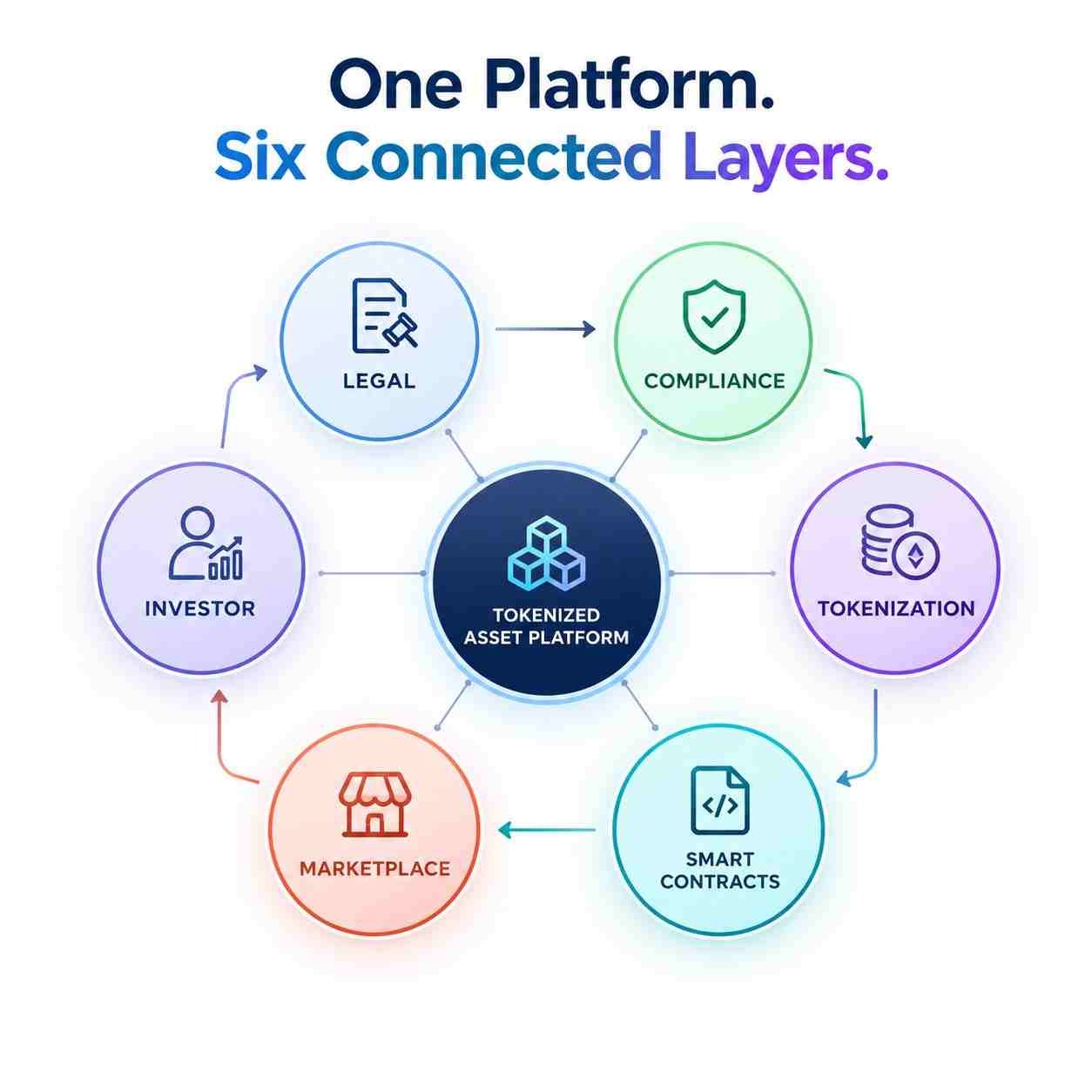
That combination is what can turn tokenization from a technical concept into usable financial infrastructure.
Conclusion: Can Tokenization Solve Real Estate's Liquidity Problem?
Tokenization can potentially make real estate more accessible, divisible, and transferable through fractional ownership, secondary-market infrastructure, and smart-contract automation.
But real liquidity still depends on legal structure, compliance, investor eligibility, and market demand.
The opportunity is clear: build the right infrastructure around the asset, not simply put it on a blockchain.
Exploring tokenization for your real estate assets?
Partner with a team experienced in Real Estate and RWA Tokenization to design a platform built around your asset, investors, compliance requirements, and business model.