One says, “Trust me, I control the process.”
The other replies, “Trust the crowd, trust the code.”
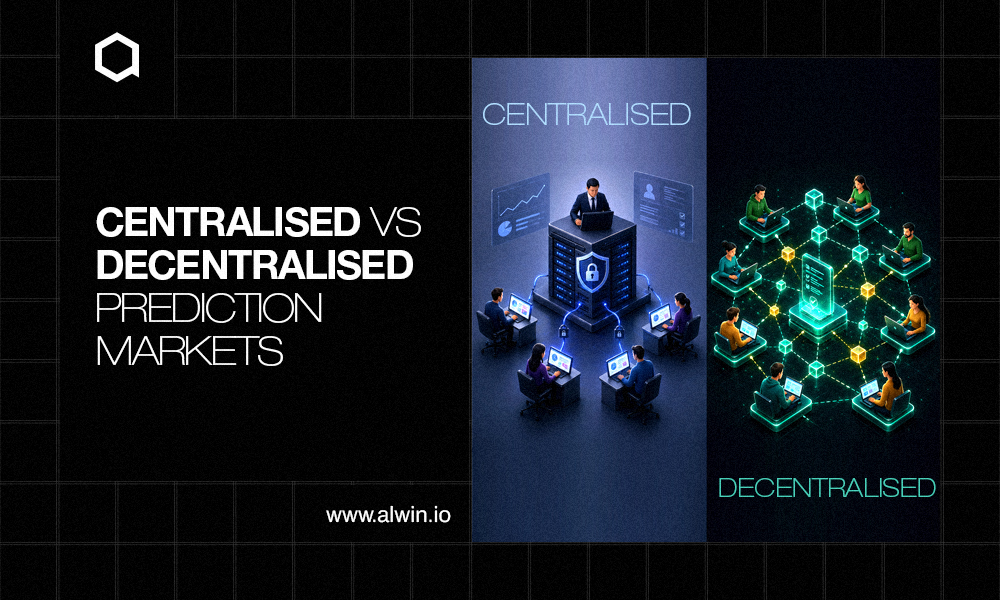
This is the silent debate powering today’s most disruptive innovation: centralised vs decentralised prediction markets.
From forecasting elections to predicting crypto trends and global events, prediction markets are no longer niche tools. They’ve become decision engines. But here’s the real question:
Which prediction market platform actually gives you the edge?
This guide doesn’t just explain the difference; it helps you think strategically, choose intelligently, and act confidently in a fast-evolving ecosystem.
“The best way to predict the future is to create it.” — Peter Drucker
What is a Decentralised Prediction Market?
A decentralised prediction market is a platform where people predict future events without depending on a single company or authority.
It runs on blockchain, so everything is open and transparent. Users can place predictions, trade based on what they believe will happen, and get rewards if their predictions are correct. The system is managed automatically using smart contracts, which means no middleman is needed.
In simple words, a decentralised prediction market lets people share their opinions on future outcomes in a secure and trust-based environment, where the technology itself ensures fairness.
Centralized Prediction Market
A centralised prediction market is a platform where people make predictions about future events, but everything is controlled by a single company or organisation.
Users can place their predictions on outcomes like elections, sports results, or market trends. The platform manages all activities such as setting rules, handling transactions, and deciding the final results.
In simple terms, it works like a system where users share their opinions, but a central authority runs and controls the entire process.
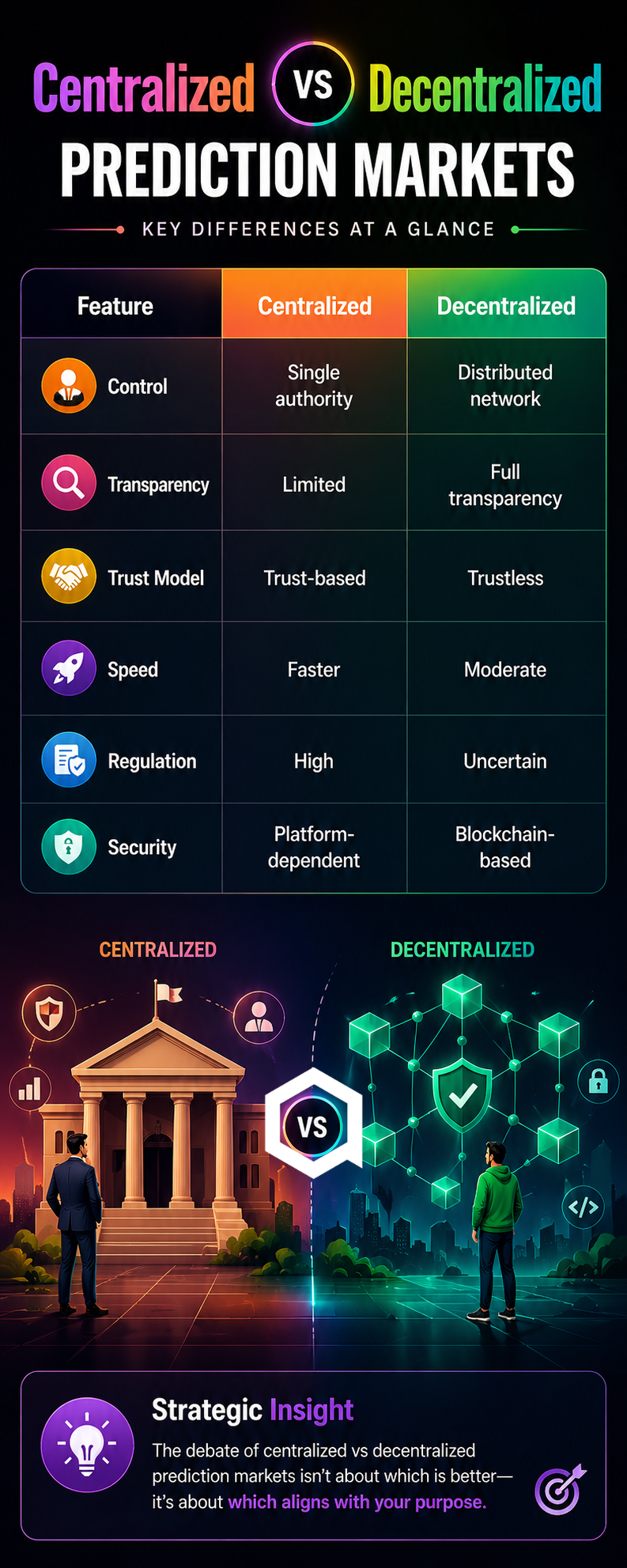
How does Centralised vs Decentralised Prediction Market Development Work?
Prediction markets are built to turn opinions into actionable data. But behind that simple idea, the development approach decides how trust, control, and execution actually happen. When you look at centralised vs decentralised prediction market development, the difference is not just technical; it changes how users interact, how outcomes are verified, and how payouts are handled.
Let’s break it down clearly.
Centralized Prediction Market Development
In a centralised system, the platform is not just a tool; it acts as the decision-maker, processor, and controller of the entire ecosystem. Every action, from creating markets to settling payouts, flows through a single authority. This makes the system faster and easier to manage, but it also means users depend on the platform’s integrity.
How it works:
1. Market Creation & Rule Setup - The platform defines the event, possible outcomes, timelines, and fees. It ensures the market is structured clearly so users can participate without confusion.
2. User Onboarding & Access - Users sign up, verify their accounts, and add funds. The platform manages user identity, wallets, and balances internally.
3. Trade Execution – Users place trades by choosing outcomes (e.g., “Yes” or “No”). The platform records every trade and updates positions in real time.
4. Price Adjustment Mechanism - Prices are adjusted using internal algorithms based on demand and supply.
Higher demand for an outcome price increases
Lower demand price decreases
This creates a dynamic market that reflects collective opinion.
5. Data Management & Monitoring - All transactions, user activities, and market data are stored in a central database. The platform monitors activity to prevent fraud, misuse, or manipulation.
6. Result Verification – Once the event ends, the platform checks the real-world outcome using trusted sources (news, APIs, and official data).
7. Settlement & Payout Distribution - The system calculates winners and distributes payouts directly to user accounts after deducting fees.
Decentralized Prediction Market Development
In a decentralised system, the platform is replaced by blockchain-based logic, where rules are written in code and executed automatically. There is no single authority controlling the process; instead, the system runs on a distributed network that ensures transparency, security, and fairness. Every action is recorded on-chain, making the entire process open and verifiable.
How it works:
1. Smart Contract Design & Deployment - Developers create smart contracts that define market rules, outcomes, deadlines, fees, and payout logic. Once deployed on the blockchain, these rules cannot be easily changed, ensuring consistency.
2. Market Creation - Anyone can create a prediction market by interacting with the smart contract. This removes dependency on a central authority and opens participation to a wider audience.
3. Wallet Connection & Fund Management
Users connect their crypto wallets and interact directly with the system.
Funds are stored in the smart contract, not controlled by any platform.
4. Trade Execution – Users place predictions by buying outcome tokens. All trades are executed directly on the blockchain, without intermediaries.
5. Automated Price Mechanism - Prices adjust automatically using algorithms like automated market makers (AMMs).
Higher demand price increases
Lower demand price decreases
This ensures a real-time reflection of collective sentiment.
6. Oracle Integration – Since blockchains cannot access external data directly, oracles are used to fetch real-world results (e.g., election outcomes and market prices).
These oracles feed verified data into the smart contract.
7. Event Resolution & Payout Automation – Once the result is confirmed, the smart contract automatically:
- Determines winning outcomes
- Distributes payouts to users
- No manual intervention is required.
What Makes a Prediction Market Platform Truly Reliable?
Live Market Responsiveness – A strong platform reacts instantly. As users place predictions, the system should update prices and probabilities in real time, without delays. This keeps the market active and meaningful.
Clear & Understandable Price Movement - Prices in a prediction market reflect what people believe will happen. A reliable platform ensures that these changes are easy to understand and logically driven by demand
Safe & Protected Transactions - Trust begins with security. Every transaction, from placing a trade to receiving payouts, should be handled with strong protection and accuracy.
Smooth & Simple User Experience - Even a powerful platform can fail if it’s hard to use. A well-designed system makes it easy for users to explore markets, place trades, and track outcomes without confusion.
Automated & Rule-Based Execution – In decentralised systems, automation plays a key role. Smart contracts handle trades and payouts automatically, ensuring that everything follows predefined rules without manual control.

Future Trends in Prediction Markets
Prediction markets are no longer limited to simple forecasting tools. As technology evolves, they are becoming more powerful, accessible, and practical for real-world decision-making. The shift in centralised vs decentralised prediction markets is shaping a future where these platforms move beyond speculation and become part of everyday strategic thinking.
AI-Driven Predictive Intelligence
Artificial intelligence is starting to play a bigger role in prediction markets. Instead of relying only on human opinions, platforms are combining user insights with AI-based data analysis.
AI can study patterns, historical data, and behaviour to improve accuracy. This creates a smarter system where predictions are not just guesses, but data-supported insights.
Rise of Hybrid Platforms
The gap between centralised and decentralised systems is slowly narrowing. New platforms are combining the speed and ease of centralised systems with the transparency of decentralised technology.
These hybrid models aim to offer the best of both worlds: a smooth user experience with reliable, trust-based execution.
Token-Based Participation Models
Tokenisation is changing how users engage with prediction markets. Instead of just placing predictions, users can earn rewards, incentives, or governance rights through tokens.
This creates a more active ecosystem where participation itself becomes valuable.
Expansion Beyond Crypto Users
Prediction markets are moving beyond tech-savvy or crypto-native audiences. With simpler interfaces and better accessibility, these platforms are reaching businesses, researchers, and everyday users.
This wider adoption will make prediction markets more relevant across industries.
Why the Right Development Partner Makes the Difference?
Building a prediction market platform today is not just about launching features; it’s about creating a system that can adapt, scale, and stay reliable over time. The real value comes from choosing a team that understands both technology and how users interact with it.
A strong development approach naturally focuses on:
- Clarity across centralized vs decentralized prediction markets
- Effortless integration of blockchain and AI capabilities
- Scalable architecture that grows without performance issues
- Tailored solutions instead of fixed, one-size models
- Continuous support that evolves with your platform
- This is exactly where teams like Wealwin stand out, not by making loud claims, but by quietly building systems that work, adapt, and last.
Because in the end, the right partner doesn’t just deliver a platform, they help you build something ready for the future.
“The future isn’t something you wait for; it’s something you design, predict, and build.”