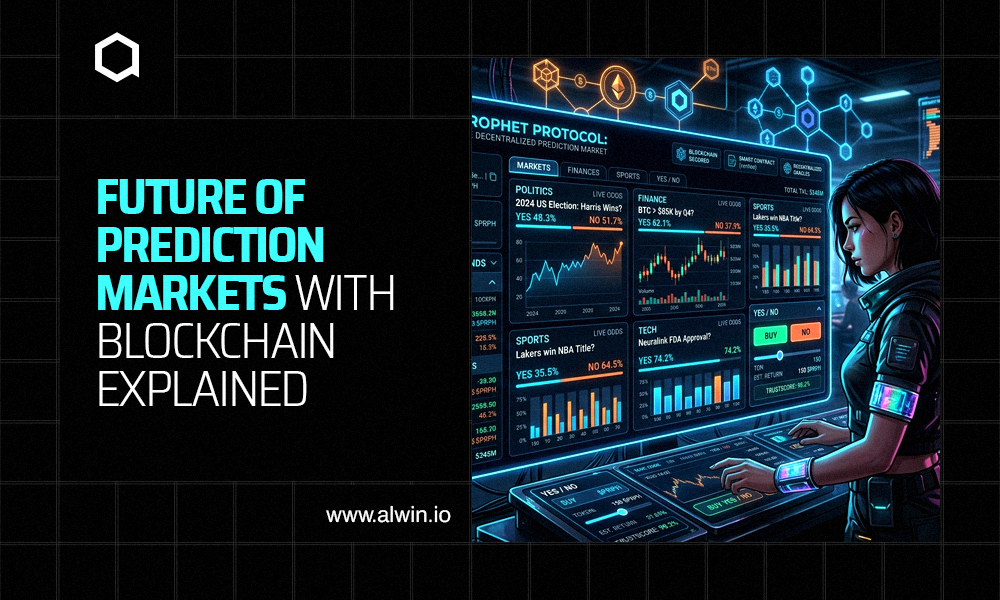
Prediction markets are one of the most interesting ways to understand what might happen in the future. Instead of guessing or relying solely on expert opinions, these markets allow people to trade based on what they expect to happen. In simple terms, they translate public opinion into numbers that represent the likelihood of an event occurring.
Research from the University of Iowa shows that prediction markets can reach 70–80% accuracy, often doing better than traditional surveys. Some studies shared by the World Bank also suggest that these markets can reduce forecasting errors by up to 30%.
Now, with blockchain technology, prediction markets are becoming more powerful than ever. Platforms like Polymarket have already handled billions in trading activity. At the same time, the blockchain industry itself is growing fast, with reports from Allied Market Research estimating it could go beyond $1 trillion by 2030.
Because of this, prediction markets are slowly becoming an important part of how people make decisions in today’s online world.
Understanding Prediction Market Development
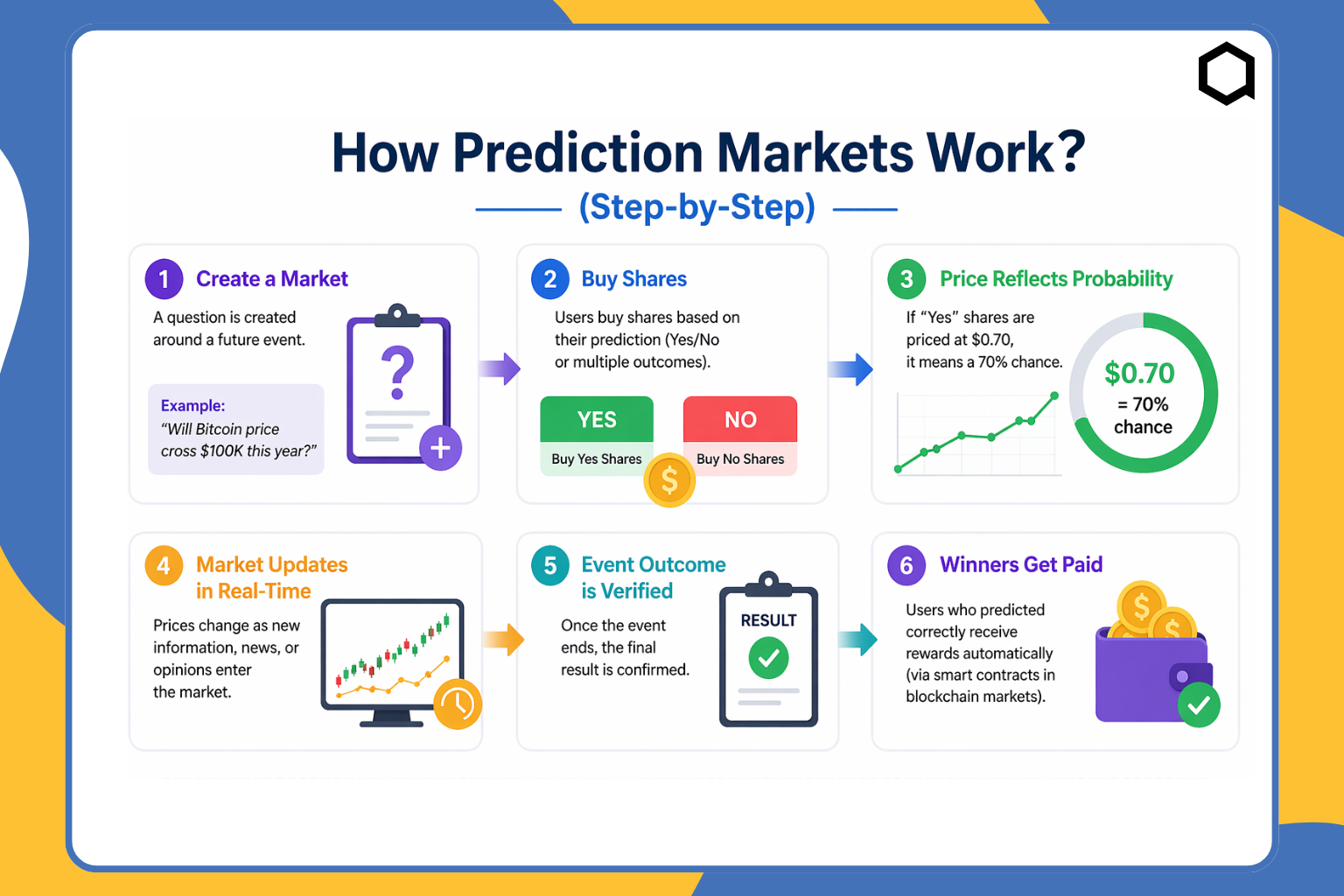
Prediction markets work in a way that is similar to stock markets. People buy and sell shares based on whether they think a specific event will happen or not. The price of these shares shows how likely the event is.
For example, if a share for “Will a new smartphone launch before December?” is priced at $0.65, it means the market believes there is a 65% chance of that event happening. As new information comes in, like news updates or expert opinions, the price changes.
This makes decentralized prediction markets active systems that keep updating all the time.
One of the main reasons they work well is crowd intelligence. Instead of depending on one person, these markets collect ideas from many people. Each person may have different knowledge or insights, and when combined, they often give a clearer picture of the future.
Also, since people may use real money, they tend to think carefully before making decisions. This leads to more accurate predictions compared to simple polls.
The Limitations of Traditional Prediction Markets
Even though prediction markets are useful, older systems have several problems that slow down their growth.
1. Lack of Trust
Most traditional platforms are controlled by a central authority. Users must trust that the platform will handle money safely and give correct results. If something goes wrong, users have little control.
2. Limited Accessibility
Some platforms are only available in certain countries or require special permissions. This stops many people from participating and reduces the variety of opinions.
3. Opaque Operations
Users cannot always see how trades are handled or how final results are decided. This lack of clarity can create doubts about fairness.
4. Inefficient Settlements
Payments can take a long time to process. In some cases, users must wait days or weeks to receive their funds after an event ends.
5. High Costs
Running a centralized system can be expensive. These costs are often passed on to users through fees.
6. Limited Features
Older platforms may not support advanced options like user-created markets or automated systems.
Because of these issues, prediction markets did not become widely used in the past. This is where blockchain technology changes things.
How Blockchain Improves Prediction Markets?
Blockchain introduces a new way of running prediction markets. It removes the need for a central authority and uses code to manage the system.
1. No Need to Trust a Middleman
Blockchain uses smart contracts, which are programs that run automatically. They handle trades and payments without human involvement. This means users do not have to depend on a company.
2. Open and Clear System
All transactions are recorded on a public ledger. Anyone can check how trades happen and verify results. This improves trust among users.
3. Open to Everyone
Anyone with internet access and a crypto wallet can join. This allows people from different parts of the world to participate.
4. Faster Payments
Once an event is finished, smart contracts can quickly release funds. This removes long waiting times.
5. Reward-Based Participation
Users can earn rewards for making correct predictions or helping the market run smoothly. This motivates people to provide better inputs.
Overall, blockchain makes prediction markets more reliable, faster, and easier to use.
Growth of Decentralized Prediction Platforms
New platforms are already showing how powerful blockchain-based prediction markets can be.
Users can:
- Create their own prediction events
- Trade using digital currencies
- Participate without needing approval from a central authority
Some platforms use systems like automated market makers (AMMs) to manage liquidity. Others allow users to vote on outcomes using tokens.
These features make prediction markets more flexible and open compared to older systems.
Why Blockchain-Based Prediction Markets are More Accurate?
Blockchain-based high-performance prediction markets often provide better results because of how they are designed.
1. Real Stakes Encourage Better Decisions
When people use real money, they are more careful. They are likely to research before making a choice.
2. Constant Updates
Prices change as soon as new information is available. This keeps predictions current.
3. More Participants
People from different regions and backgrounds take part. This improves the overall quality of predictions.
4. Clear and Automatic Process
All activities can be checked, and results are handled automatically. This reduces errors and bias.
Because of these reasons, prediction markets can perform better than surveys or expert opinions, especially when situations change quickly.
Real-World Applications of Prediction Markets
Prediction markets are now being used in many industries beyond simple event forecasting. Their ability to collect public opinion, market behavior, and probability-based predictions makes them useful for planning, forecasting, and risk analysis.
1. Financial Markets
Prediction markets help users understand and monitor:
- Market trends
- Interest rate changes
- Economic signals
- Cryptocurrency price movements
- Stock market expectations
Investors, traders, and financial analysts can use this information to study market sentiment and make better investment decisions based on collective market activity.
2. Governance and DAOs
Decentralized organizations and DAOs use prediction markets to evaluate possible outcomes before making important decisions. Community members can participate in forecasting governance proposals, voting outcomes, and project performance. This helps organizations choose better strategies and improve decision-making processes.
3. AI and Data Systems
Prediction markets can work together with AI-based systems to:
- Verify predictions
- Improve forecasting models
- Learn from real-world outcomes
- Analyze user behavior and trends
This combination can help create smarter systems that improve accuracy over time through continuous learning and market feedback.
4. Risk Management
Businesses can use prediction markets to study and manage risks related to:
- Supply chains
- Government rules and regulations
- Product launches
- Market demand changes
- Business expansion plans
This helps companies prepare for possible challenges in advance and reduce unexpected business risks.
5. Sports and Entertainment
Prediction markets are also becoming popular in sports and entertainment sectors where users forecast match outcomes, player performance, award results, and entertainment trends. This increases user participation and platform activity.
Future Trends in Prediction Markets
Prediction markets are expected to grow in the coming years as businesses, investors, and users look for smarter ways to forecast real-world events and market outcomes.
1. AI Integration
AI-powered tools may actively participate in prediction markets by studying historical data, analyzing user behavior, identifying market patterns, and making automated predictions with better accuracy. This can improve market efficiency and help users make faster decisions.
2. DeFi Connection
Prediction marketplace development may connect with decentralized finance (DeFi) systems such as crypto lending, staking, insurance, and liquidity protocols. This integration can create more transparent and secure ecosystems for users.
3. Easier-to-Use Platforms
Future prediction market platforms are expected to focus on user-friendly interfaces, mobile accessibility, and simple onboarding processes. Even users without blockchain or trading knowledge may easily participate in prediction activities.
4. Business Adoption
More companies may begin using prediction markets for business planning, product launches, customer behavior analysis, risk management, and internal forecasting. This can help organizations make better strategic decisions.
5. Clear Rules and Regulations
Improved government regulations and legal frameworks may increase trust among users and investors. Clear compliance standards can support safer transactions, wider adoption, and long-term platform growth.
Conclusion
Blockchain is changing how prediction markets operate. Removing middlemen, improving transparency, and speeding up processes make these platforms more reliable, secure, and accessible for users across different industries.
Prediction markets are no longer limited to guessing outcomes or event forecasting. They are gradually becoming powerful systems that help individuals, businesses, and organizations make better decisions based on collective knowledge, public opinion, and market participation.
As uncertainty continues to grow in areas such as finance, sports, politics, business planning, and global events, tools that help predict possible outcomes will become more valuable. Blockchain-based prediction markets provide a practical approach by combining community participation, reward systems, decentralized technology, and real-time market updates.
With the support of AI, DeFi integration, and growing global adoption, prediction marketplace platforms may continue expanding into new industries and business models in the coming years.
In the end, the future may favor those who can make informed predictions, analyze market behavior, and respond quickly to changing trends, rather than relying solely on simple guesses.