Your NFT marketplace has NFTs. But why aren’t users trading?
You launched the platform, added NFT collections, connected wallets, and enabled buying and selling. On paper, everything looks ready. Yet the marketplace still feels quiet.
This is where many businesses run into the same problem. NFT Marketplace Development Services are not just about putting digital assets on a blockchain. A marketplace needs to make it easy for users to discover NFTs, trust what they see, complete transactions, and have a reason to come back.
If your platform has plenty of listings but little or no trading activity, the problem may not be the wide variety of NFTs. It may be everything happening around them.
Here are seven challenges well worth fixing earlier than simply including extra digital collectibles.
Building an NFT Marketplace Is More Than Listing Digital Collectibles
The old marketplace journey was straightforward:
Mint → List → Buy → Sell
But that is no longer enough for many marketplace business models.
Users now expect something closer to:
Discover → Trust → Buy → Own → Use → Trade → Return
That change creates a bigger development challenge.
You can have hundreds of NFTs listed and still struggle to generate transactions. You can attract users and still have weak liquidity. And you can add dozens of features while making the buying experience harder to understand.
The blockchain is only one part of the platform. The marketplace also needs to address discovery, security, usability, utility, performance, and market requirements.
So, where do these issues commonly appear?
Why are NFTs Listed but Not Selling?
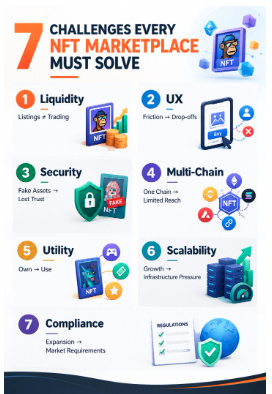
Challenge #1: Solving the Liquidity Problem
This is one of the first problems a marketplace can face: lots of listings, but not enough trading.
A seller can list an NFT in seconds. That does not mean the right buyer will find it.
Why Is Liquidity Difficult to Build?
Users need a reason to browse, compare, buy, and trade. If finding relevant NFTs is difficult or the marketplace feels inactive, buyers may leave before making a purchase.
At the same time, sellers need enough buyer activity to keep listing their assets.
That creates a cycle:
Fewer buyers → fewer sales → fewer active sellers → less marketplace activity.
How Can a Marketplace Encourage More Trading?
The solution starts with making active inventory easier to discover.
A marketplace can support:
- Better NFT discovery
- Search and filtering
- Collection-based browsing
- Secondary-market trading
- Clear pricing
- Multiple payment options
- Collection visibility
- Buyer and seller activity indicators
The goal is not simply to increase the number of NFTs on the platform. It is to help the right buyers find the right assets.
Solution takeaway: Build around trading behavior, not just NFT inventory.
Why Do Interested Buyers Leave Before Completing a Purchase?
Challenge #2: Removing Friction From the NFT Buying Journey
Imagine a user finds an NFT they like. Then the platform asks them to connect a wallet, switch networks, calculate gas, approve a transaction, sign another request, and wait for confirmation.
For an experienced Web3 user, that may be normal. For everyone else, it can feel like too much work.
Where Does the Buying Experience Break?
Common friction points include:
- Wallet connection
- Network switching
- Gas fees
- Transaction signing
- Failed transactions
- Unclear transaction status
- Complicated onboarding
Even when the underlying blockchain transaction works correctly, the user experience can still feel confusing.
What Should Businesses Improve?
A good marketplace should make each step easy to understand.
That means clear onboarding, simple wallet integration, transparent fees, straightforward transaction instructions, useful search, and a mobile-friendly interface.
Users should know what they are doing, what they are paying, and what happens next.
The blockchain should provide the infrastructure without forcing users to understand every technical detail behind it.
Solution takeaway: Make the buying process feel straightforward without hiding important transaction information.
What If Users Can’t Tell Whether an NFT Is Genuine?
Challenge #3: Building Trust Through Verification and Security
A buyer sees an NFT collection. How do they know it is authentic?
That question becomes especially important when marketplaces deal with creators, brands, gaming assets, memberships, or high-value digital assets.
Why Can Trust Become a Problem?
NFT ecosystems can include copied artwork, fake collections, impersonated creators, malicious smart contracts, and compromised wallets.
If users have to investigate every asset themselves, the marketplace is putting too much responsibility on the buyer.
What Can a Marketplace Do?
Security and verification should be considered during development rather than treated as post-launch additions.
Depending on the platform, useful measures can include:
- Creator verification
- Collection verification
- Contract-address validation
- Ownership history
- Smart contract audits
- Wallet security
- Transaction monitoring
The idea is simple: users should have enough information to understand what they are buying and where it came from.
Solution takeaway: Trust should be built into the marketplace architecture, not added after launch.
Why Is Your Marketplace Reach Limited to One Blockchain?
Challenge #4: Breaking the Single-Chain Marketplace Limitations
Starting with a single blockchain can make development easier. But what happens when your users want assets from another ecosystem?
Different chains have different communities, NFT standards, wallets, transaction costs, and infrastructure.
How Can a Single Chain Become a Limitation?
Imagine your target audience uses several blockchain ecosystems, but your marketplace supports only one.
You may end up excluding potential users and collections before they even reach the platform.
Blockchain fragmentation can also divide liquidity and user activity across separate ecosystems.
Is Multi-Chain Support the Answer?
For some business models, multi-chain support can be useful.
A multi-chain NFT marketplace can be designed to support selected networks while giving users a more consistent experience.
This may involve:
- Multi-chain architecture
- NFT standard support
- Wallet compatibility
- Network-specific infrastructure
- Cross-chain functionality
- Unified marketplace discovery
- But supporting every blockchain is not automatically better.
The right networks should be selected based on your users, NFT categories, transaction requirements, and business model.
Solution takeaway: Choose blockchain networks strategically instead of adding chains simply for the sake of having more options.
Why Would Users Keep an NFT After They Buy It?
Challenge #5: Giving NFTs Utility Beyond Collecting
Here is a question marketplace founders should ask:
What happens after the NFT is purchased?
If the answer is simply “the user owns it,” the asset may have limited long-term value within the platform.
What Can NFTs Actually Do?
NFTs can represent much more than digital artwork.
Depending on the business model, they can support:
- Memberships
- Gaming assets
- Event access
- Loyalty programs
- Digital certificates
- Exclusive experiences
For example, an NFT could act as a membership pass, unlock a gaming feature, provide event access, or represent a loyalty benefit.
That gives users a reason to interact with the asset after the original transaction.
Why Does Utility Matter?
Utility can turn ownership into an ongoing experience.
Instead of:
Buy → Own → Leave
the experience can become:
Buy → Own → Use → Engage → Trade → Return
That creates a stronger foundation for ongoing marketplace engagement.
Solution takeaway: Give users a reason to care about the NFT after the purchase.
What Happens When Your Marketplace Finally Gets Traction?
Challenge #6: Preparing the Marketplace for Scale
Getting your first users is one challenge.
Handling a much larger number of users is another.
A marketplace may work perfectly during early testing and then start showing performance problems once traffic, listings, searches, and transactions increase.
Where Can Scaling Problems Appear?
More activity means more data to process and more blockchain-related operations to manage.
You may eventually deal with:
- Large NFT collections
- High search volumes
- Metadata requests
- Transaction activity
- Wallet interactions
- Indexing demands
- Increased API traffic
If the architecture is not prepared for that growth, users may experience slow pages, delayed NFT loading, indexing problems, or failed requests.
What Should Be Considered During Development?
A scalable NFT marketplace platform can use:
- Efficient backend architecture
- NFT indexing
- Database optimization
- Cloud infrastructure
- Load testing
- Performance monitoring
- Efficient API and data handling
The point is not to build for unlimited traffic on day one. It is to avoid creating an architecture that becomes a bottleneck when the business starts growing.
Solution takeaway: Plan for future marketplace activity before performance becomes a business problem.
Can You Expand Into New Markets Without Rebuilding the Platform?
Challenge #7: Planning for Compliance and Market Expansion
There is another issue founders sometimes discover too late: market requirements.
The rules and expectations surrounding digital assets can differ between jurisdictions and business models.
Where Can Compliance Become Relevant?
Depending on the platform, businesses may need to consider:
- Target jurisdictions
- KYC/AML requirements where applicable
- Geographic restrictions
- User verification
- Asset classification
- Data privacy
- Transaction records
These requirements can affect how users are onboarded, how transactions are processed, what data is stored, and where the platform can operate.
Why Think About It During Development?
Trying to add market-specific controls after the platform is already built can create unnecessary technical changes.
Instead, businesses can identify their target markets early and consider the relevant requirements while designing the platform.
Legal and regulatory requirements should be reviewed with qualified professionals for the jurisdictions involved.
Solution takeaway: Understand market requirements before finalizing the platform architecture.
From 7 Marketplace Problems to One Scalable Platform
When you put all seven challenges together, a pattern becomes clear.
The marketplace does not need more features simply for the sake of having more features. It needs the right infrastructure for the problems the business expects to solve.

This is where NFT Marketplace Development can bring these technical pieces together to create a platform built around your users, business model, and marketplace requirements.
Depending on the business model, development may include marketplace architecture, smart contracts, NFT standards, wallet integration, multi-chain support, payment systems, security, admin tools, analytics, and scalability planning.
The better question is not:
“How many features can we put into the marketplace?”
It is:
“Which capabilities will actually solve our users’ and business’s problems?”
Choosing a Trusted NFT Marketplace Development Company: What Should You Actually Evaluate?
Don’t Choose a Development Partner Based Only on Features
A provider can show you an impressive feature list. That does not necessarily tell you how they will handle liquidity, security, scalability, blockchain fragmentation, or user experience. When evaluating the Best NFT Marketplace Development Company for your project, look beyond the demo.
What Should You Look for in an NFT Marketplace Development Company?
- Evaluate experience across:
- Blockchain architecture
- Smart contract security
- Multi-chain development
- Marketplace UX
- Scalability planning
- Wallet and payment integrations
- Security testing
- Post-launch support
You want to understand how the provider approaches the problems behind the features.
Questions to Ask Before Starting
Before selecting an NFT Marketplace Development Company, ask:
- How will you approach marketplace liquidity?
- Which blockchains fit our target users?
- How will NFTs and collections be verified?
- How will smart contracts be tested and secured?
- How will the platform handle increased activity?
- How will market-specific requirements be incorporated?
The answers can tell you much more than a long list of development features.
NFT Marketplace Pre-Launch Checklist: Have You Solved the Right Problems?
Before launch, ask your team:
Liquidity: Who will buy, sell, and trade?
User Experience: Where could users abandon the buying journey?
Security: How will authenticity and ownership be verified?
Blockchain: Which networks do your users actually need?
Utility: What can users do with the NFT after buying it?
Scalability: What happens when marketplace activity increases?
Compliance: Which markets and requirements must the platform support?
If you can answer these questions clearly, you are thinking beyond simply launching an NFT listing platform.
Building an NFT Marketplace That Solves Real Market Challenges
An NFT marketplace is not successful simply because users can mint, list, and purchase NFTs.
The bigger challenge is everything happening around those transactions:
Liquidity. UX. Security. Blockchain access. Utility. Scalability. Compliance.
That is what separates a platform that simply hosts NFTs from one designed around how users actually discover, trust, buy, own, use, and trade digital assets.
So before adding another collection or another feature, ask a more important question:
What problem is the marketplace solving for the people who will actually use it?
Build the technology around that answer.