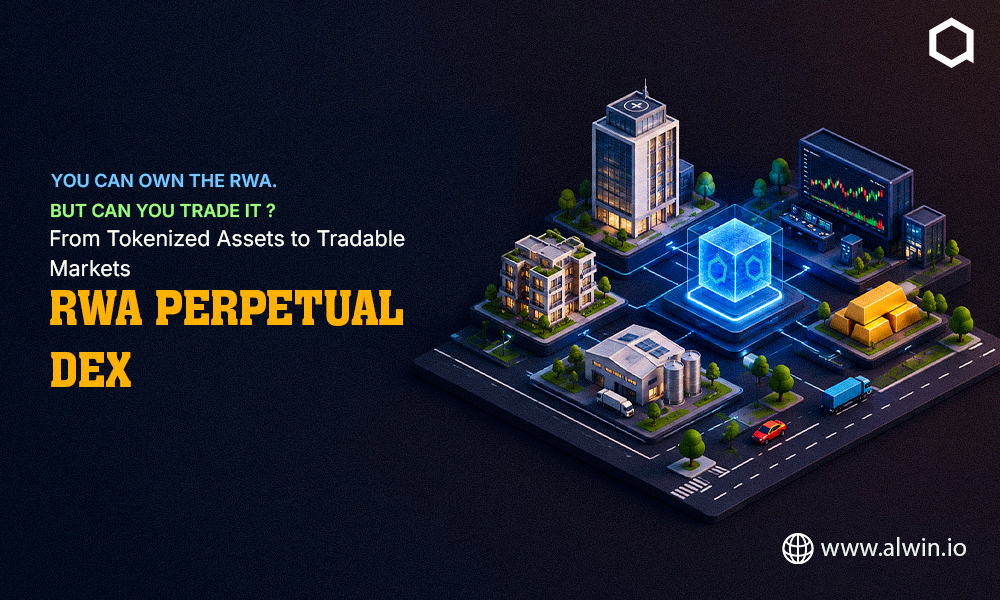
You invested in an RWA because you believed it would grow in value.
But what happens when your view changes?
What if the price starts moving against you and you want to hedge? What if the market suddenly presents a short opportunity? What if you need to exit but there isn’t enough liquidity to do it efficiently?
Owning the asset is only half the investment story.
The bigger question is, can you actually manage your position when the market gives you a reason to act?
That is where the conversation around RWA Perpetual DEX begins.
RWA Perpetual DEX: From Tokenized Ownership to Active Trading
Tokenizing a real-world asset puts ownership and asset exposure on-chain, but it does not automatically create a liquid market around it. Investors still need ways to trade price movements, manage risk, hedge exposure, and respond when market conditions change.
An RWA Perpetual DEX extends the tokenization model by creating an on-chain environment for trading perpetual contracts linked to selected real-world assets. Instead of simply holding tokenized assets, investors can potentially take long or short positions, manage exposure, and participate in markets designed for continuous trading.
As RWAs move from digital ownership toward active financial markets, the focus is shifting from “Can this asset be tokenized?” to “Can investors actually trade and manage its exposure?”
You Own the RWA, But What Happens When You Need to Move?
Owning a tokenized real-world asset can give investors digital ownership or exposure to something with tangible value. But ownership does not automatically mean there is a deep, liquid market waiting on the other side of every trade.
Imagine you hold an RWA and suddenly want to reduce your position. You place an order, but there aren't enough buyers at the price you expect. The market is thin, the available liquidity is limited, and the trade may take longer or cost more than you planned.
This is where the difference between owning an asset and being able to trade its exposure becomes important.
A token can exist on-chain without having an active secondary market behind it. Investors may still face:
Limited liquidity: A tokenized asset may have value, but not enough active buyers and sellers to support smooth execution.
Fewer counterparties: If only a small number of participants are willing to trade, entering or exiting a position can become difficult.
Shallow secondary markets: Low market depth can lead to higher slippage, especially when an investor wants to move a larger position.
Restricted trading opportunities: Traditional market hours or limited venues can prevent investors from acting when market conditions change.
Slow exits: When liquidity is limited, selling an RWA may not be as simple as clicking “sell.”
The important point is that putting an asset on-chain does not automatically create an efficient market for it.
An RWA can have strong underlying value and still leave an investor asking a very practical question:
“If I need to act on my position right now, who is on the other side of my trade?”
That question is becoming increasingly important as tokenized assets move from simply representing ownership toward becoming actively traded financial markets.
You Don’t Just Need to Own the RWA. You Need the Freedom to Act on It.
Investing in an RWA doesn't end when the token reaches your wallet. That is often when the real questions begin.
What if you want to exit?
If the market is thin and buyers are limited, selling a sizeable position can mean accepting slippage, waiting for liquidity, or leaving capital tied up longer than expected.
What if the market turns against you?
Holding the underlying RWA doesn't automatically give you a simple way to hedge your exposure. You may believe in the asset for the long term while still wanting protection against a short-term price decline.
What if you spot an opportunity without wanting to buy the asset itself?
This is where perpetual contracts become interesting. Instead of purchasing the underlying asset directly, investors can potentially take a leveraged long or short position based on its price movement, subject to the market's margin and risk mechanisms.
And why should your trading opportunity depend on a traditional market clock?
Markets move because news breaks, sentiment changes, and opportunities appear at different times. A 24/7 on-chain trading environment can give investors more flexibility to manage positions as those conditions change.
These are not separate problems. They point to one larger gap:
Investors don't just need access to tokenized assets. They need markets that give them more ways to enter, manage, hedge, and exit their positions.
That is the problem an RWA Perpetual DEX is designed to address.
TOKENIZATION CREATES ACCESS.
LIQUIDITY CREATES FLEXIBILITY.
MARKET INFRASTRUCTURE CREATES ACTION.
This Is Where an RWA Perpetual DEX Changes the Conversation
An RWA Perpetual DEX takes the conversation beyond simply owning a tokenized asset. It creates an on-chain market where investors can trade price exposure to selected real-world assets through perpetual contracts.
Think of the flow simply:
RWA → Price Feed → Perpetual Market → Collateral → Position → Funding → Liquidation
The investor chooses a market, deposits collateral, and opens a long or short position based on their market view. Behind the scenes, price feeds, funding mechanisms, margin rules, and liquidation systems work together to keep the market functioning.
How Does It Change the Investor Experience?
|
Traditional RWA Market
|
RWA Perpetual DEX
|
|
Primarily focused on asset ownership
|
Focuses on trading price exposure
|
|
Liquidity may be limited.
|
Built for continuous market activity
|
|
Mainly supports spot exposure
|
Enables long and short positions
|
|
Fewer ways to hedge
|
Designed to support hedging strategies
|
|
More capital may be tied to ownership.
|
Uses collateral and margin
|
|
Trading can follow traditional market limitations.
|
On-chain markets can operate 24/7.
|
The difference is simple: traditional RWA markets answer how investors can own an asset, while perpetual markets focus on how they can actively manage their view of its price.
That shift can make tokenized assets more interesting from a trading and risk-management perspective.
An RWA perpetual market becomes valuable when it gives investors more ways to respond to changing market conditions. Instead of simply holding an RWA and waiting, investors can potentially use perpetual contracts to take positions, manage risk, and act on their market views.
What Investors Actually Gain From RWA Perpetual Markets?
1. The Freedom to Take Both Long and Short Positions
Markets don't always move in one direction. If an investor expects an RWA's price to rise, a long position can express that view. If they expect a decline, a short position can provide a way to act on that outlook.
This gives investors more flexibility than simply buying and holding the underlying asset.
2. Hedge Without Giving Up the Underlying Asset
Selling an RWA isn't always the preferred choice just because the short-term outlook has changed.
For example, an investor may still believe in an asset over the long term but be concerned about a temporary decline. A perpetual position can potentially be used to offset part of that downside exposure while the underlying asset remains in the portfolio.
3. Put Capital to Work More Efficiently
Perpetual markets use collateral and margin rather than requiring traders to purchase the full value of the underlying asset.
That can allow an investor to gain larger market exposure with less upfront capital. But greater capital efficiency comes with greater risk. Leverage can magnify losses, and positions can be liquidated when available margin falls below required levels.
4. Trade When the Opportunity Appears
Market-moving events don't wait for an exchange to open.
News, economic data, sentiment, and global events can change an asset's price at any time. Because blockchain-based markets can operate around the clock, an RWA perpetual market can give investors the ability to manage positions beyond traditional trading hours.
5. Access Built Around the Rules of the Market
Global accessibility doesn't mean unrestricted access.
An RWA perpetual platform may need to determine who can trade, which assets are eligible, and where users are permitted to participate. KYC requirements, jurisdictional restrictions, asset eligibility, and other compliance controls can be built into the platform where applicable.
The goal is not simply to make RWA trading more accessible. It is to create a market where investors have more control over how they enter, manage, hedge, and exit their positions within the rules that govern the asset and the market.
Putting an RWA On-Chain Is Only the Beginning. The Real Opportunity Is Building a Market Around It
Real-world asset tokenization can bring real-world value onto the blockchain, but putting an asset on-chain doesn't automatically create a functioning market around it.
Investors still need reliable prices, sufficient liquidity, efficient execution, and ways to manage their positions. For an RWA Perpetual DEX, all of this has to work together behind a simple trading interface.
The infrastructure needs to handle:
- Reliable price oracles to keep market prices accurate and up to date.
- Liquidity provisioning to help traders enter and exit positions efficiently.
- Funding mechanisms to keep perpetual markets balanced.
- Margin and collateral management to control leveraged positions.
- Liquidation systems to respond when positions no longer meet margin requirements.
- Risk controls to manage excessive exposure and unusual market activity.
- Smart-contract security to protect funds and trading logic.
- Compliance and access controls to support applicable KYC, jurisdiction, and asset-eligibility requirements.
- Real-time monitoring to detect abnormal activity and respond quickly.
This is why Decentralized Exchange Development for RWAs is more than building a trading dashboard. The interface is what investors see; the pricing, liquidity, risk, security, and compliance systems underneath are what make the market usable.
The relationship is simple:
Real World Asset Tokenization → Asset Representation → Data & Compliance → Market Infrastructure → RWA Perpetual DEX → Tradable Exposure
Tokenization answers:
“How do we bring the asset and its rights on-chain?”
Perpetual infrastructure answers the next question:
“How can investors actually trade and manage exposure to it?”
That second question is where the real market opportunity begins.
What Could Investors Trade Through an RWA Perpetual DEX?
From gold and treasuries to equities and real estate exposure, RWAs can open new markets for investors. The real opportunity is turning tokenized value into tradable price exposure.
Potential RWA Markets
Tokenized Commodities — Trade exposure to commodities such as gold and other real-world resources.
Gold-Backed Assets — Take long or short positions based on gold price movements.
Treasury-Related Assets — Gain exposure to tokenized Treasury markets through perpetual positions.
Tokenized Equities — Trade equity price exposure where the structure and regulations permit.
Real Estate-Related Assets — Create markets around tokenized real-estate exposure.
Private-Credit Markets — Explore perpetual exposure through suitable credit benchmarks or representations.
Not every tokenized asset is ready for perpetual trading. Reliable pricing, sufficient liquidity, market data, legal structure, and strong risk controls are essential before turning an RWA into a viable perpetual market.
The Oracle Problem: What Price Should an RWA Perpetual Market Trust?
A perpetual market is only as reliable as the price it trades against. When real-world assets meet on-chain markets, accurate, timely, and verified pricing becomes the foundation of every position.
RWA markets often depend on asset prices that originate outside the blockchain. That data must be collected, compared, validated, and delivered on-chain before it can power trading, funding, margin, or liquidation.
What the Pricing Layer Needs to Handle
Off-chain asset prices — Bring real-world market data into the trading environment.
Oracle feeds — Deliver verified prices to smart contracts.
Data aggregation — Compare multiple sources instead of relying on a single feed.
Manipulation protection — Detect unusual price movements and suspicious inputs.
Stale-price detection — Prevent outdated data from driving live positions.
Low-liquidity monitoring — Flag assets where price discovery may be unreliable.
Deviation monitoring — Identify unexpected gaps between trusted price sources.
Circuit breakers — Pause or restrict activity when pricing moves beyond defined limits.
Because when the oracle gets the price wrong, the impact goes beyond a bad chart. A trader could enter, exit, or be liquidated based on a price that does not accurately reflect the underlying asset.
Tokenization Puts Assets On-Chain. The Next Step Is Making Them Tradeable.
RWA markets are moving beyond simply putting real-world assets on-chain. The evolution is becoming clearer:
Put assets on-chain → make them transferable → create secondary liquidity → enable derivatives and hedging → connect them with broader DeFi markets.
That shift changes the opportunity. The next challenge may not be tokenizing more assets but building better markets around the assets already being tokenized.
Imagine finding a tokenized asset you believe in. You research it, understand the opportunity, and take a position.
Then the market moves.
Can you hedge it? Can you manage the exposure? Can you exit efficiently?
That is where tokenization alone reaches its limit.
Real World Asset Tokenization brings real-world value on-chain. An RWA Perpetual Decentralized Exchange can take it further by giving investors a market to trade, hedge, and manage that exposure.
Because putting an asset on-chain creates access.
Building the market around it creates opportunity.