The stock market has always been driven by predictions, where prices will move, which sectors will rise, and what investors believe comes next. But in today’s digital era, those predictions are no longer just guesses, they’re becoming tradable assets through intelligent marketplaces.
That’s where a Stock Market Prediction Marketplace Development plays a powerful role. By combining real-time market data, forecasting models, user participation, and secure trading systems, these platforms allow users to predict stock movements and earn rewards based on accurate insights.
Imagine a platform where users forecast whether a stock will rise or fall, trade positions instantly, and gain collective intelligence to make smarter decisions. As demand for smarter financial platforms grows, businesses entering this space now have the chance to lead a fast-emerging industry. With the right Stock Market Prediction Marketplace Development Company, you can build a scalable, data-driven platform designed for the future of investing.
What is the Stock Market?
The stock market is a place where investors buy and sell shares of publicly listed companies. When you purchase a stock, you own a small part of that company and can benefit if the company grows in value or pays dividends.
Real Data & Stats on People Investing in Stocks 📊
United States 🇺🇸
- 62% of Americans in 2025 own stocks, either directly or through retirement accounts like 401(k)s or mutual funds. This is the highest level since before the 2008 financial crisis.
- U.S. households had a record 45.4% of total assets invested in equities in 2025.
United Kingdom 🇬🇧
- 58% of UK adults have invested in some form by 2026, with an estimated 31.7 million people participating.
- 41% of Brits have owned stocks and shares, making it the most popular investment type.
Retail Investor Growth 🌍
- U.S. retail investors traded a record $6.6 trillion worth of stocks in the first half of 2025.
- Gen Z and lower-income groups are investing at record rates, with below-median income young investors being 5x more likely to invest than a decade ago.
Why the Stock Market Is Trending Right Now?
AI Boom Is Driving Market Growth
Artificial Intelligence has become the biggest market theme in 2026. Major tech companies are investing heavily in AI infrastructure, cloud computing, and semiconductors. Analysts note that AI-related spending is helping push markets higher.
👉 Stocks linked to AI are attracting huge investor interest globally.
Markets Near Record Highs
The U.S. stock market has remained near all-time highs, with the S&P 500 and Nasdaq supported by strong earnings and technology stocks. Big Tech continues to lead the rally.
👉 This creates confidence and brings more new investors into the market.
Retail Investors are Entering Fast
Retail participation is exploding. According to a 2026 investor survey:
- 58% of individual investors plan to buy more stocks in 2026
- Only 4% plan to reduce exposure
- 68% of Gen Z and 64% of millennials plan to increase stock investments
👉 Younger generations are making the stock market more mainstream than ever.
Stock Market Apps Changed Everything
Investing is now easier than ever through mobile apps and digital brokers. People can buy stocks instantly, use fractional investing, and track portfolios in real time.
👉 What once needed brokers and paperwork now takes seconds.
Sector Rotation Is Creating New Opportunities
2026 isn’t only about tech. Investors are also watching:
- Energy stocks
- Financials
- Small-cap stocks
- International equities
Professional investors say opportunities are broadening beyond Big Tech.
Stock Market Prediction Marketplace
A Stock Market Prediction Marketplace is a digital platform where users predict future stock market movements and trade based on those forecasts. Instead of directly buying stocks, participants place predictions on outcomes such as whether a stock price will rise, fall, hit a target, or outperform another stock. In simple terms, it combines the power of the stock market, prediction markets, and crowd intelligence into one interactive platform.
What is Stock Market Prediction Marketplace Development?
Stock market prediction marketplace development refers to the process of building a digital platform where users can forecast stock price movements and trade based on those predictions. Instead of buying actual stocks, users participate by predicting outcomes such as whether a stock will rise, fall, or reach a specific price within a given timeframe. These predictions are converted into tradable contracts, where the price reflects the probability of that outcome happening.
How Stock Market Prediction Marketplaces Work? Step-by-Step Process
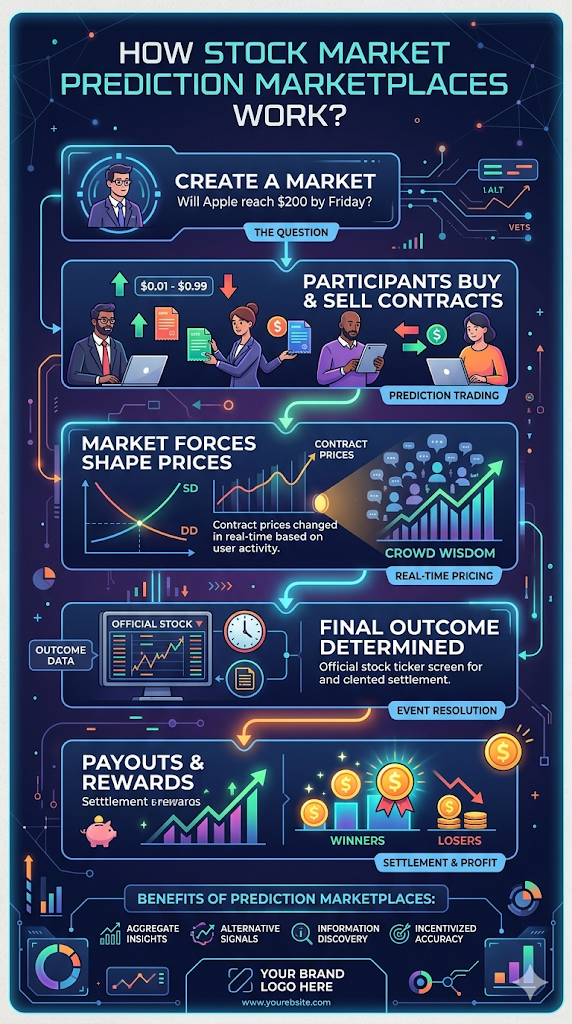
A Stock Market Prediction Marketplace works like a trading platform where users forecast future stock movements and earn rewards for accurate predictions. Instead of buying actual shares, users trade on outcomes and probabilities.
Here’s the complete step-by-step process:
1. Market Creation
The platform first creates prediction markets based on stocks, indexes, or sectors.
Examples:
Will Tesla, Inc. rise 10% this month?
Will Apple Inc. beat earnings expectations?
Will the NASDAQ Composite close higher this week?
Each market includes rules, expiry date, and outcome options.
2. Users Join the Platform
Users create accounts, add funds, and browse available prediction markets. They choose markets based on their stock knowledge, research, or market sentiment.
3. Analyze Data & Trends
Before placing predictions, users study:
- Stock charts
- Earnings reports
- News events
- Technical indicators
- Market sentiment
This helps them make smarter decisions.
4. Buy Prediction Positions
Users then purchase positions like:
- Yes (stock will rise)
- No (stock will not rise)
- Multiple price range outcomes
- Prices usually range between $0 and $1 based on probability.
👉 Example: If “Yes” is priced at $0.70, the market believes there is a 70% chance it happens.
5. Real-Time Trading Begins
As more users buy or sell positions, prices move dynamically. If confidence rises, prices go up. If sentiment weakens, prices fall. This creates an active marketplace similar to live trading.
6. Users Can Exit Early
Before the market closes, users can sell their positions to lock profits or cut losses based on changing stock conditions.
7. Event Ends & Result Verified
Once the expiry date arrives, the platform checks real stock market data using trusted feeds.
Example:
Did Tesla, Inc. close above the target price?
The final result is then confirmed.
8. Winning Users Get Paid
Winning positions settle at full value (commonly $1 per share), and users who predicted correctly receive profits.
Losing positions expire worthless.
9. Platform Earns Revenue
The marketplace earns through:
- Trading fees
- Transaction commissions
- Premium analytics
- Subscription plans
Key Features of a Stock Market Prediction Marketplace
A successful Stock Market Prediction Marketplace requires more than simple trading tools. It must combine real-time stock data, intelligent forecasting systems, secure transactions, and an engaging user experience. These powerful features help users predict stock movements confidently while allowing businesses to build a scalable fintech ecosystem.
Real-Time Prediction Markets
The platform should support live prediction markets based on current stock prices, earnings announcements, market trends, and economic events. Users can join active markets anytime and place predictions before deadlines. Real-time market creation keeps the platform fresh, engaging, and continuously active.
Dynamic Pricing Engine
A dynamic pricing system automatically adjusts the value of prediction shares based on user demand and sentiment. If more users believe a stock will rise, the “Yes” price increases instantly. This creates a transparent probability-based marketplace and makes trading more exciting.
Stock-Based Event Creation
The marketplace should allow administrators to create custom prediction events around stocks, sectors, or indexes. This could include price targets, quarterly earnings outcomes, weekly trends, or sector performance. Flexible market creation ensures a wide variety of opportunities for users.
Live Charts & Market Data
Integrated stock charts, real-time price feeds, volume indicators, and technical tools help users make informed decisions. Access to updated market data increases trust and enables smarter predictions instead of random guesses.
Secure Wallet & Payments
Users need a fast and secure system for deposits, withdrawals, and payouts. Payment gateways, UPI, bank transfer options, cards, and crypto wallets can be integrated to support global transactions. An errorless payment experience increases user retention.
User Dashboard
A personalized dashboard gives users complete visibility into their activity. They can track active predictions, completed trades, profits, losses, wallet balance, and historical performance. A well-designed dashboard improves user experience and engagement.
AI-Powered Insights
Modern platforms can include AI tools that analyze market sentiment, stock momentum, historical trends, and news impact. These insights help users make data-driven predictions and add premium value to the platform.
Instant Settlement System
Once a prediction market expires, the system verifies results using trusted stock market data providers. Winning users receive payouts instantly without manual delays. Fast settlements improve user trust and platform credibility.
Multi-Market Support
The platform can host multiple categories of prediction markets at once. Users may participate in stock price forecasts, index movement predictions, earnings-based markets, IPO expectations, and sector performance events. This keeps the platform diversified and highly engaging.
Leaderboard & Reward System
Gamification features such as leaderboards, badges, seasonal contests, and referral rewards encourage more participation. Users enjoy competing with others while improving retention and community growth.
High-Level Security
Strong security features such as encryption, two-factor authentication, KYC verification, fraud monitoring, and secure wallet systems are essential. Since the platform handles money and data, trust and protection must be top priorities.
Mobile App Accessibility
A mobile-friendly web platform or dedicated app allows users to trade and predict anytime from anywhere. Push notifications for market openings, price changes, and payouts keep users connected at all times.
Admin Control Panel
The admin panel allows operators to manage users, create markets, monitor transactions, control commissions, and analyze platform growth. A strong backend system is necessary for smooth business operations.
Analytics & Reporting
Detailed analytics dashboards help both users and platform owners understand performance trends. Reports on active users, revenue, popular markets, and prediction accuracy help optimize growth strategies.
Steps to Develop a Stock Market Prediction Marketplace
Building a Stock Market Prediction Marketplace requires the right mix of fintech technology, real-time data systems, secure trading infrastructure, and user-friendly design. A successful platform allows users to predict stock outcomes, trade positions, and earn rewards through accurate forecasts.
Here is the complete step-by-step development process:
1. Define the Business Model & Market Niche
The first step is deciding how your marketplace will operate and who it will serve. You need to choose whether the platform will focus on stocks, indexes, IPO predictions, earnings results, or sector movements. At this stage, revenue models such as trading fees, subscriptions, premium analytics, or referral programs are also planned.
2. Conduct Market Research & Competitor Analysis
Study successful platforms, fintech trends, and user demand before development begins. Understand what features users expect, what competitors are missing, and where you can create a unique advantage. Strong research reduces risk and helps shape a profitable platform strategy.
3. Plan the Platform Architecture
A robust technical architecture is essential for speed and scalability. This includes designing the frontend, backend, database structure, trading engine, payment modules, APIs, and admin systems. A well-planned architecture ensures the platform can handle large user traffic smoothly.
4. Design a Modern UI/UX Interface
The user experience must feel simple, fast, and engaging. Create intuitive dashboards, prediction pages, live charts, wallet sections, and portfolio tracking screens. A clean design helps new users participate easily while keeping advanced users active.
5. Build the Prediction Trading Engine
This is the core of the marketplace. The engine should allow users to buy and sell prediction positions such as “Yes” or “No” outcomes. It must process trades instantly, update prices in real time, and manage user balances accurately.
6. Integrate Real-Time Stock Market Data
Your platform needs trusted financial data feeds for stock prices, indexes, earnings reports, and market movements. Real-time data integration keeps markets accurate and allows users to make informed predictions.
7. Develop Dynamic Pricing Algorithms
Prediction shares should move based on demand and sentiment. If more users believe a stock will rise, prices increase automatically. Smart pricing models create fairness, excitement, and transparent market probabilities.
8. Add Wallet, Payment & Withdrawal Systems
Users must be able to deposit funds, participate in markets, and withdraw winnings easily. Integrate payment gateways, UPI, cards, banking systems, or crypto wallets depending on your target audience.
9. Implement Security & Compliance
Since money and personal data are involved, security is critical. Add KYC verification, two-factor authentication, fraud detection, encryption, and secure transaction protocols. Regulatory compliance builds trust and protects the platform.
10. Build Admin Panel & Market Controls
The admin dashboard allows operators to create markets, monitor users, manage commissions, track transactions, and control platform settings. This backend system is essential for smooth business operations.
11. Testing & Quality Assurance
Before launch, every module should be tested thoroughly. This includes payment testing, trading speed, data accuracy, mobile responsiveness, security checks, and stress testing for heavy traffic conditions.
12. Launch the MVP Version
Start with a Minimum Viable Product (MVP) containing essential features such as market creation, user accounts, wallet system, and live predictions. Launching early helps validate demand and gather user feedback.
13. Add Advanced Features After Launch
Once traction begins, scale the platform with premium features like AI stock insights, copy prediction tools, social trading, referral systems, gamification, and leaderboards.
14. Growth Marketing & User Acquisition
After development, focus on growth through SEO, influencer campaigns, fintech communities, referral rewards, and digital advertising. Strong marketing is what turns a platform into a profitable business.
Future Trends in Stock Market Prediction Markets
Stock Market Prediction Markets are rapidly evolving into one of the most exciting innovations in fintech. As AI, retail investing, and real-time trading continue to grow, these platforms are expected to reshape how people interact with financial markets. The future is moving beyond traditional investing toward predictive, interactive, and reward-driven ecosystems.
- AI-Driven Market Forecasting
- Real-Time Event Trading
- Blockchain-Based Transparency
- Social Trading Communities
- Mobile-First User Experience
- Personalized Prediction Feeds
- Expansion Beyond Stocks
Final Note
The stock market has always been driven by one powerful idea predicting what happens next. Today, that concept is transforming through advanced Stock Market Prediction Marketplace Development, where users do more than watch charts, they participate, forecast outcomes, and earn from accurate insights.
This new generation of platforms combines finance, technology, and crowd intelligence into one dynamic ecosystem. With real-time data, AI-powered analytics, secure transactions, and rising investor interest, prediction marketplaces are creating a smarter and more engaging way to experience the markets.
For startups and enterprises, the opportunity is bigger than ever. As demand for innovative fintech products grows, partnering with the right prediction marketplace development company can help you launch faster, scale efficiently, and build a future-ready platform that stands out in a competitive market.
The future of trading will not be limited to buying and selling stocks, it will be about predicting trends, trading probabilities, and monetizing market intelligence.
👉 The question is no longer if this market will grow, it’s who will lead it first. 📈