Tokenized RWAs as DeFi Collateral: What Founders Get Wrong About RWA DeFi Integration?

Prev 75 Views
Total Words 1082 Total Words
Reading Time 6 mins read

Have Questions or Doubts?

share Share
                  
tokenized-rwa-defi-collateral-integration-mistakes

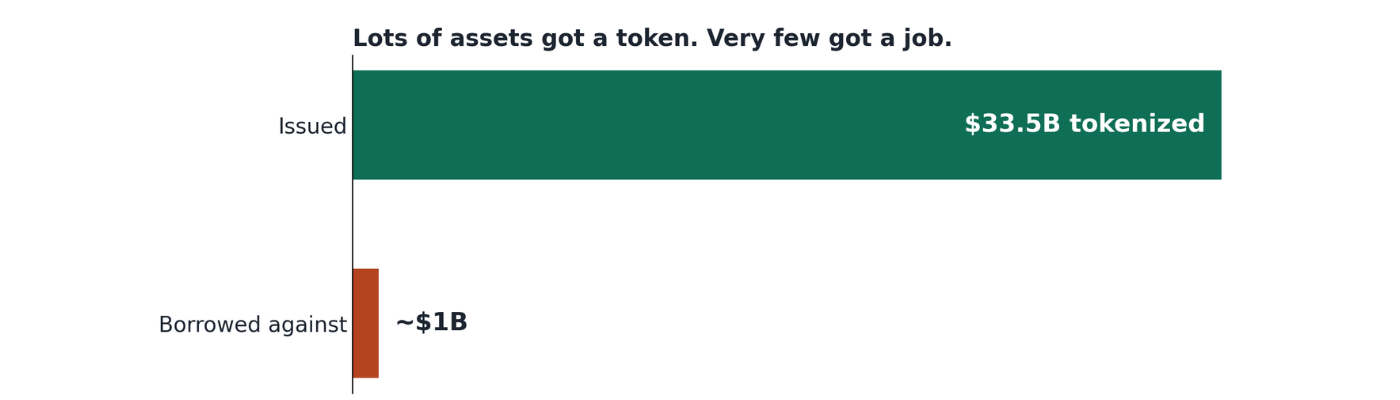
Here's the number that should keep RWA founders up at night. Tokenized real-world assets have passed $33.5B on-chain, yet loans outstanding against them sit near $1B.


Lots of assets got a token. Very few got a job.

Call it the RWA hangover. Or, if you prefer it in four lines:

                Mint it, list it, shout it loud,

                then watch it sit there in the crowd.

               Tokens are cheap, but trust is earned,

               and collateral is where it's learned.

It isn't because the idea is broken. In April 2026, BlackRock, Standard Chartered and OKX announced a framework letting BUIDL be posted as yield-bearing trading collateral: one pot of money, earning interest and backing positions at the same time. It works. The question is why so few RWA products get the same call-up.

The answer is four boring fixes: the asset, the exit, the permissions and the paperwork. Founders who nail those get the job. The rest get a press release. Let's take them one by one.

First, proof it works

Forget theory. Here's what is live right now.

⦁ Aave Horizon is a permissioned market where institutions post tokenized Treasuries and similar assets to borrow stablecoins. It holds around $256M. Real, but modest.

⦁ Sky (ex-MakerDAO) keeps about $4.8B in short-term government securities through its peg stability module, the biggest number on this list.

⦁ Spark put $800M of its $1.5B RWA allocation into BUIDL in February 2026.

⦁ DBS Bank accepted Franklin Templeton's tokenized money-market fund as loan collateral back in September 2025.

The model isn't a myth. It's just narrower than the pitch decks claim, and the winners so far are mostly Treasuries and money-market funds.


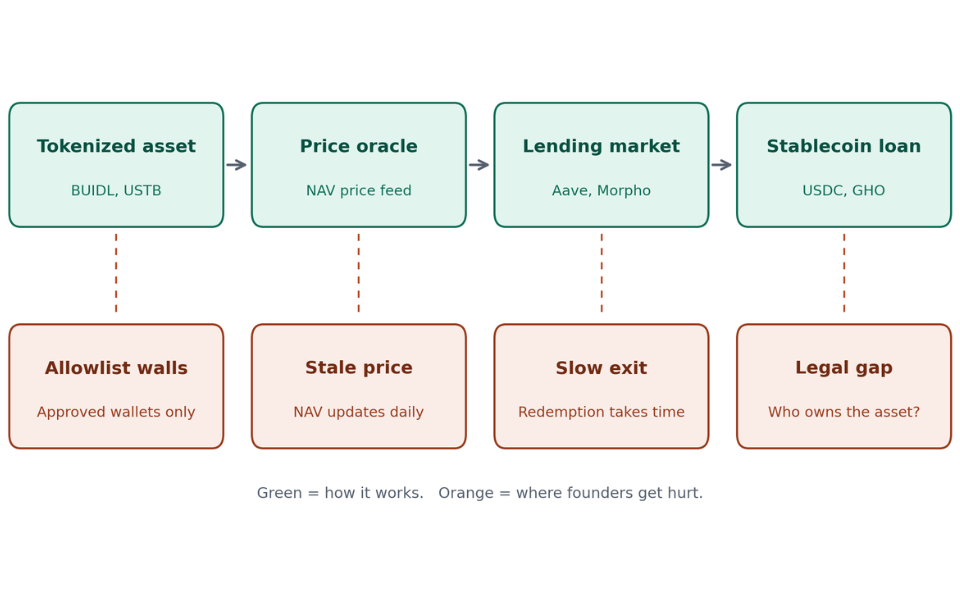
The RWA collateral flow, with a failure point under every step


Mistake 1: treating every RWA the same

"Real-world asset" is a label, not a risk grade. Tokenized Treasuries can carry loan-to-value ratios of 90% to 95%. Tokenized property sits closer to 30% to 40%, because it's hard to sell in a hurry.

The property end already had a wobble: RealT, a property-token issuer, went into liquidation in 2026. Pretty on-chain, patchy off-chain. If the legal wrapper is weak, the token is just a nicely formatted promise.

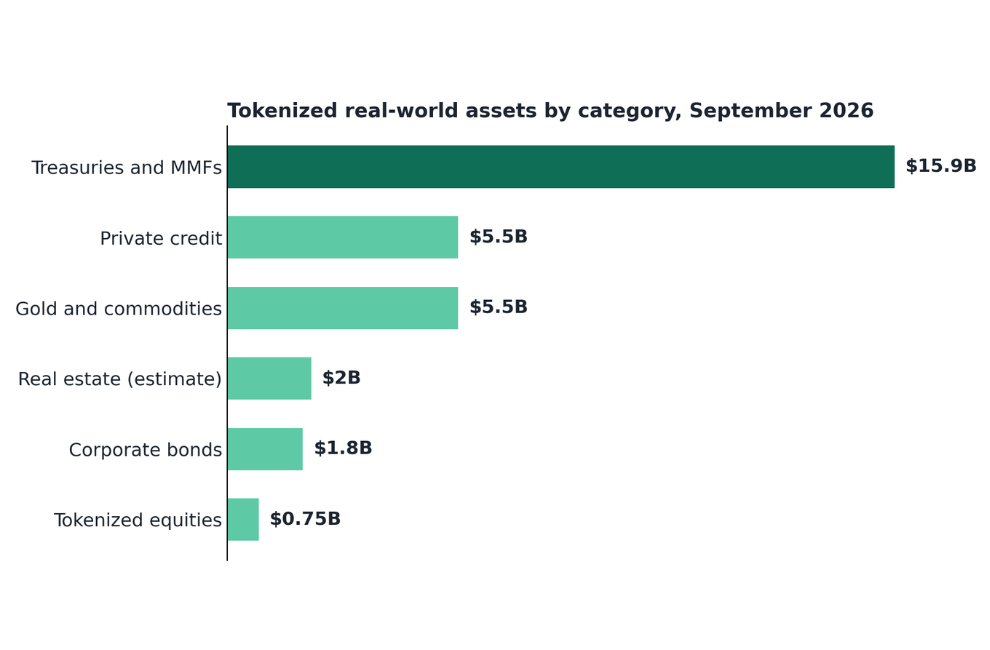
Tokenized RWAs by category, September 2026. Treasuries lead; the rest is a thin spread. 

Source: CoinPaprika RWA data.


            Start boring. Liquid assets, priced daily. Fancy comes later.


Mistake 2: Designing the entry and forgetting the exit

Every founder maps how collateral goes in. Few map how it comes out. If a borrower defaults, the protocol has to sell, and a fund that redeems over a day or two can't be dumped like ETH in a second. Slow to sell means quick to fail.

So build your liquidation plan around the slowest link in the chain, not the fastest. One question settles it: if we must sell on a bad Tuesday, who buys, and how fast?


Mistake 3: Fighting the allowlist

DeFi purists hate permissions. Institutions love them, and they hold the capital. Standards like ERC-3643 keep most institutional RWA collateral inside permissioned pools, and that is where markets like Aave Horizon and Morpho's curated vaults sit.

Even BUIDL's April 2026 collateral deal runs through a regulated custodian, Standard Chartered. The pattern is clear: the money that scales arrives wearing a compliance badge.


Mistake 4: Treating the regulator as an afterthought

Dubai isn't waiting around. In April 2026, VARA published guidance sorting token launches into three buckets and tightening disclosure and governance for Real-World Assets and stablecoins. The message is simple: Dubai wants RWAs, and it wants them done properly.

Whether your team sits in Business Bay or Canary Wharf, serious capital asks about custody, legal title and disclosure before it asks about yield.


The real reason lenders say no

Here's the pattern behind all four mistakes. A lender doesn't ask, "Is your token clever?" It asks three plain questions. Can I price it today? Can I sell it tomorrow? Can I prove it's mine if things go wrong? Treasuries and money-market funds tend to pass all three, which is why they lead Figure 2 and carry the highest loan-to-value ratios. Property tokens struggle on at least two. Answer those three questions on your first slide, and the rest of the pitch gets a lot easier to say yes to.


Should you build on RWA collateral now, or wait?

Short version: build now if your asset is liquid, your legal title is clean, and your market can live with permissioned access. Start smaller, or wait, if you're tokenizing something slow to sell, like property, or if nobody can tell you who owns the underlying asset on a bad day.

Here's a sensible path for most teams:

  • Pick one boring asset. A Treasury or money-market fund token is the easiest place to prove the model.
  • Start with cautious limits. Launch with conservative loan-to-value ratios and widen them only once you've seen how liquidations really behave.
  • Sort custody and licensing first. Choose your custodian and regulatory route before you write the contracts, not after.
  • Treat the first six months as a stress test. You're proving it survives a rough week, not racing for a growth chart.

The upside is real. The market is already shifting from tokens that sit idle to tokens that earn and back loans. The founders who get there first won't be the fastest. They'll be the ones still standing after the first rough week.


Your five-minute checklist

    ⦁ Asset: is it liquid and priced at least daily?

    ⦁ Legal: does the token give an enforceable claim on the asset?

    ⦁ Oracle: what happens when the price feed goes stale?

    ⦁ Exit: can you liquidate in hours, not days?

    ⦁ Licence: which regulator covers this, and is it in writing?

Five yeses and you're ahead of most of the market.


The bottom line

Tokenized RWAs can be real DeFi collateral. BlackRock, Aave and Sky have shown it. But the winners won't be the loudest decks. They'll be the founders who sweat the dull stuff: legal title, liquidity and licensing. Build for the bad day, and the good days look after themselves.

      Building an RWA collateral product? Run your exit plan through the checklist above before you write a single line of smart contract.

Sources

RWA in DeFi: How Real World Assets Are Transforming Decentralized Finance 

RWA as DeFi Collateral: How It Works and Why It Matters 

The Next Phase in RWA Tokenization: From Issued Assets to Usable Portfolios 

Dubai’s VARA Clarifies Token Issuance Rules for Stablecoins and RWAs 

Latest Blogs

FAQ

A: Tokenized RWAs often involve off-chain ownership, limited liquidity, complex legal rights, and pricing challenges. Integrating them into DeFi requires reliable connections between the physical or financial asset and its blockchain representation.

A: Incorrect valuations can allow borrowers to take excessive loans or leave lenders undercollateralized. Reliable price oracles, independent appraisals, and conservative collateral ratios help reduce these risks.

A: Unlike highly traded crypto assets, real estate, private credit, and other RWAs may take time to sell. During market stress, this can complicate liquidations and increase the risk of bad debt.

A: Founders should verify asset ownership, establish enforceable token-holder rights, assess jurisdiction-specific regulations, and implement appropriate investor eligibility and transfer controls.

A: Essential safeguards include audited smart contracts, manipulation-resistant price oracles, automated liquidation rules, collateral monitoring, access controls, and mechanisms for handling valuation updates and underlying asset changes.