Real-time insights, rapid execution, remarkable results” — the future of AI-powered trading. In recent years, the trading industry has experienced a major shift with the adoption of AI-powered algorithmic trading software. Businesses are increasingly using advanced trading technologies to improve trading accuracy, automate market analysis, and execute trades faster than traditional manual methods.
AI-based algo trading platforms are designed to analyze large volumes of real-time market data, identify profitable trading opportunities, and perform automated trades with minimal human intervention. This helps businesses reduce manual errors, improve decision-making, and manage market risks more effectively.
“Smart strategies, faster trades, stronger profits — AI is powering the future of modern trading.”
From cryptocurrency exchanges and stock trading firms to fintech startups and investment companies, organizations are investing in AI-driven trading solutions to gain a competitive advantage in the financial market. With the rapid growth of AI-powered algo trading, businesses are focusing more on faster execution, smart analytics, and automated strategies, making algorithmic trading software an important part of modern trading infrastructure.
What Is AI-Powered Algo Trading Software?
AI-powered algo trading software is an advanced trading system that uses artificial intelligence, machine learning, and automated algorithms to analyze market trends and execute trades automatically.
Instead of depending on human emotions or manual calculations, the software follows predefined strategies and real-time market signals. These systems can monitor multiple markets simultaneously, identify profitable patterns, manage risks, and place trades within milliseconds.
Many businesses prefer AI-powered trading platforms because they reduce manual errors and improve decision-making accuracy. Modern trading software can also learn from historical market behavior and continuously optimize trading strategies over time. With the evolution of Algo Trading Software 2.0, businesses are now adopting smarter and more adaptive trading systems that deliver faster execution, advanced analytics, and improved automation capabilities.
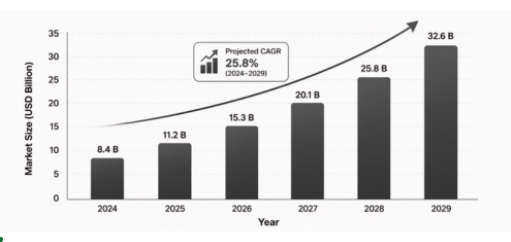
Recent Updates in AI-Powered Algo Trading Software
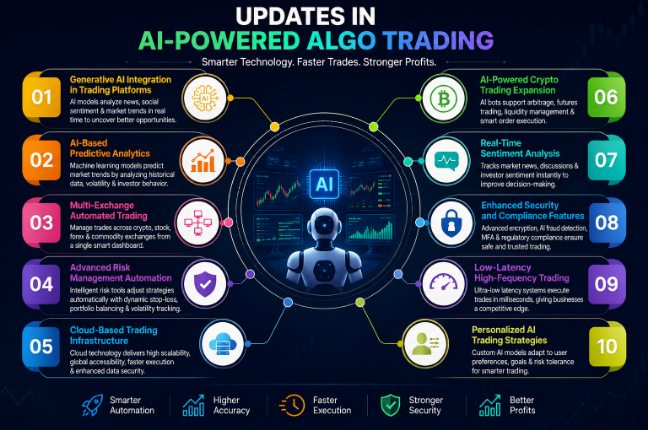
AI-powered algo trading is revolutionizing modern finance with smarter automation, faster execution, advanced analytics, and intelligent risk management.
Why Businesses are Rapidly Adopting AI Trading Platforms?
1. Faster Trading Execution
In financial markets, speed matters the most. Even a one-second delay can affect profits. AI-powered algo trading systems can execute thousands of trades instantly based on real-time market data.
This allows businesses to react quickly to market changes and capture opportunities before competitors.
2. Reduced Human Errors
Manual trading often leads to emotional decisions, calculation mistakes, or delayed execution. AI trading software removes these issues completely by following automated strategies with precision.
3. 24/7 Market Monitoring
Different human traders, AI trading platforms can work continuously without breaks. This is especially useful for cryptocurrency markets that operate 24/7 globally.
4. Better Risk Management
Modern algo trading platforms include advanced risk management tools like stop-loss automation, portfolio balancing, and real-time alerts. These features help businesses reduce trading risks and improve long-term stability.
5. Data-Driven Decision Making
AI systems analyze huge amounts of historical and live market data to generate accurate trading signals. Businesses can make smarter investment decisions using predictive analytics and automated insights.
Services Offered in AI-Powered Algo Trading Software Development
Companies are helping businesses build scalable and intelligent algorithmic trading platforms with advanced automation features.
Based on their algo trading development solutions, businesses can access services such as:
|
Service
|
Purpose
|
Business Benefit
|
|
Custom Algo Trading Software Development
|
Build trading platforms based on custom strategies
|
Full business control and scalability
|
|
AI Trading Bot Development
|
Automate crypto and stock trading activities
|
Faster and emotion-free trading
|
|
Strategy Backtesting
|
Test strategies using historical data
|
Reduces trading risks
|
|
Real-Time Market Analytics
|
Analyze live market movements
|
Better trading decisions
|
|
API & Exchange Integration
|
Connect with multiple exchanges and brokers
|
Smooth multi-platform trading
|
|
Risk Management Systems
|
Automated stop-loss and monitoring tools
|
Improved capital protection
|
|
Cloud-Based Trading Infrastructure
|
Access trading systems from anywhere
|
High scalability and uptime
|
|
Portfolio Management Features
|
Track investments and trading performance
|
Better financial management
|
These services are becoming essential for businesses entering the fintech and crypto trading industries. Many companies are also investing in Crypto Exchange Algo Trading Development to enable automated crypto trading, liquidity management, and real-time market execution across multiple exchanges.
Real-Time Examples of AI Algo Trading Usage
Cryptocurrency Exchanges
Crypto exchanges are using AI-based trading bots to provide automated trading features for users. These bots can execute high-frequency trades, monitor volatility, and improve liquidity management.
Hedge Funds
Many hedge funds rely on algorithmic trading systems to analyze market trends and manage large investment portfolios efficiently.
Retail Trading Platforms
Modern fintech apps now offer automated copy trading and AI-driven investment suggestions to attract beginner investors.
Institutional Investors
Banks and financial institutions use algorithmic systems for portfolio balancing, arbitrage trading, and market prediction analysis.
These real-world applications show how AI trading technology is becoming a core part of modern finance.
Development Cost and Timeline of Algo Trading Software
The cost of developing AI-powered algo trading software depends on features, integrations, security systems, and customization levels.
|
Development Type
|
Estimated Cost
|
Development Timeline
|
|
Basic Trading Bot
|
$8,000 – $15,000
|
1 – 2 Months
|
|
Mid-Level Algo Trading Platform
|
$20,000 – $45,000
|
3 – 5 Months
|
|
AI-Powered Advanced Trading Software
|
$50,000 – $120,000+
|
6 – 12 Months
|
|
Enterprise Multi-Exchange Trading Platform
|
$150,000+
|
12+ Months
|
Businesses usually invest more in security, AI analytics, and scalable infrastructure because these elements directly affect trading performance and user trust.
Important Features Businesses Look for in Algo Trading Software
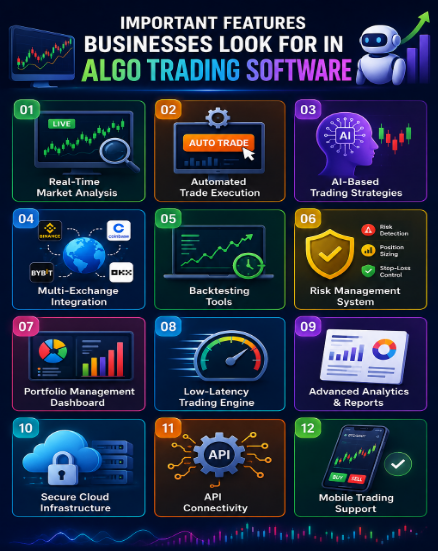
Companies offering professional algo trading development services focus heavily on security, scalability, and performance optimization because financial platforms require high reliability.
Future of AI-Powered Algorithmic Trading
The future of algorithmic trading is strongly connected with artificial intelligence and machine learning. Businesses are now moving toward smarter platforms that can automatically adapt to changing market conditions.
Advanced technologies like predictive AI analytics, deep learning models, and real-time trading automation are expected to dominate the next generation of financial platforms.
‘Faster insights, flawless execution, future-ready profits” — powered by AI-driven algorithmic trading.’ is transforming the future of digital finance.
According to recent industry studies, AI-driven trading systems are improving trading efficiency, reducing operational costs, and helping businesses scale faster in competitive markets.
Final Thoughts
AI-powered algo trading software is no longer just a trend in the fintech industry. It has become a practical business investment for companies that want faster execution, better accuracy, improved automation, and long-term growth.
Businesses are actively investing in intelligent trading platforms to stay ahead in modern financial markets. From crypto exchanges and hedge funds to fintech startups and investment firms, AI-based trading systems are helping organizations trade smarter and operate more efficiently.
With the growing demand for advanced Algo Trading Software Development, businesses are focusing on building secure, scalable, and automation-driven trading ecosystems that can adapt to rapidly changing market conditions.
Companies like WeAlwin Algo Trading Solutions are supporting businesses with custom AI-powered trading software, automated trading bots, real-time analytics, cloud-based infrastructure, and scalable fintech solutions designed for future-ready trading ecosystems.
‘Next-generation strategies for next-level trading success” — powered by AI and automation.’